Licking Shoes & Homemade Tattoos: The comics of Liz Suburbia

4 10 2011

One crucial night, in a seedy back alley of the internet, I stumbled across Liz Suburbia‘s Sacred Heart comic. It’s more polished than the comic trash I usually gravitate towards, but I immediately felt that magical tingle of familiarity you get when encountering a kindred weirdo. Sacred Heart is about high school punks and somehow manages to be both wholesome and pervy at the same time. It’s full of angst and relationship pathos, teen psychics, dogs, blowjobs in the woods, homemade tattoos and barfing all drawn in Liz’s confident line.

Immediately after reading Sacred Heart I needed another fix, so I wrote to Liz and ordered a copy of her mini Cyanide Milkshake — possibly my favorite comic fanzine in the past 10 years. Sex, punk, and B-movie references fill every page. Goofy ads for fake products like Man Merkins and movies like the post-apocalyptic blockbuster Sex Beserkers (Rated G for GWAR) are interspersed with short narratives featuring weirdo teens, zombies and dogs. Her storytelling/joke style (and even her art to some degree) reminds me of early Dork/Milk & Cheese-era Evan Dorkin. Another reason that this comparison keeps occurring to me is because they both seem to be steeped in comics culture in a similar way. Liz works full-time at a comic book store and draws comics on her days off. You can’t be a lightweight and keep that up.

Waiting for the next Cyanide Milkshake to hit my mailbox is fucking torture. In the meantime, to ease my comics blue balls, I asked Liz Suburbia some questions…

Janelle Blarg: It’s bizarre and kind of magical to me that I’d never heard of you until last year, but you obviously draw all the time and have a fully developed artistic style. Where did you come from? Or rather, when did you start drawing comics and when did you start publishing them?

Liz Suburbia: I HAVE TRAVELED HERE FROM THE YEAR 1984 TO MAKE COMICS FOR YOU ALL. It was a long trip and I started it as a baby. I think I’ve always been drawing and writing little stories going as far back as I can remember; my first real effort though was a goofy autobiographical web comic I started at the end of high school, followed by my first zine a few years later. That early stuff was pretty bad though, I think I had to get out and go through some shit and learn a lot more about life before I started making comics I was satisfied with. I started Sacred Heart about two years ago and in that time have started self-publishing Cyanide Milkshake and some other minis as well.

Sacred Heart is your ongoing series about high school punks and weirdos. How much of it is biographical? (Really, I want to know if you knew a guy like Otto who would hang out under the bleachers and lick shoes).

Ha! It’s weird because it takes place in my old hometown, and all the kids went to my old high school and all the landmarks are from real life, but I’m not trying consciously to make it too personal, you know? I get asked a lot if Ben is supposed to be me, which makes me uncomfortable because she’s really not intended that way, but I guess all your characters have a little bit of you in them. Maybe I shouldn’t have made her a dark-haired girl with a big nose. Otto is kind of a composite of my partner, my high school boyfriend, and a couple other guys, but as far as I know none of them ever foot-perved under the bleachers. I wouldn’t put it past them though.

I like that there are no parents featured in Sacred Heart. Just like Peanuts. Parents are boring! Censor them! Was that a conscious decision?

It’s actually a big part of the plot, though I’m not gonna tell why until the next book (which is going to take place about ten years after this one). Hopefully it won’t take me ten actual years to get that far into the story. I work at a snail’s pace and I have a day job, though, so it might be awhile.

The sneaky handjob scene between Otto and Bennie is perfect. That’s such a classic high school experience. You’re just hanging out with your friend on the couch and the next thing you know — bam! Wandering hand! I guess this is not a question. I just want to talk about the sex scenes in your comics because they are all brilliant.

It means a lot that people seem to really like the sex scenes, because they’re a big deal to me. There’s a lot of sexualization in comics that’s alienating or problematic and I really want the sex my characters are having to be more human and positive. I like my comics loaded with sex but it really takes the right approach for it to actually come off as honestly sexy, or at least realistically awkward, you know? I dunno, I grew up really repressed so I just hope it’s not too obvious that I’m working my issues out in comic form or whatever. One thing I can guarantee is that there’s lots more fucking still to come. Heh.

Sacred Heart is only online for now, right? Do you have any plans to produce a print copy? What are your feelings about print vs. online publishing?

Yeah, my plan is to finish this first book online and then see about getting it published. Whether I put it out myself or if someone else is interested, we’ll see, and then go from there. I like print because I’m kind of old fashioned: it’s nice to have an object to pass between friends, plus print is ultimately harder to monitor and censor. There’s a lot of accessibility that comes with publishing online though, and it’s important to me that anyone who wants to read it be able to, whether they have internet access or not or whether they can get their hands on a book without spending more than they can spare, or whatever. Ideally, I’d like to have a nice print copy of Sacred Heart for those who want it, but to still leave it up online in some form for everyone else. We’ll see.

What are your cartooning weapons of choice? Typically, how long does it take you to complete a page?

For Sacred Heart I use Bristol board and pens, though I’m working my way up to nibs because I’m a serious fucking artist y’all. I usually get two new pages done on the two days a week I don’t work, so I guess my rate is about a page a day. With Cyanide Milkshake and my minis, though, I just use computer paper and Sharpies. They’re supposed to be loose and fun, so I try not to let my anal retentive tendencies get the better of me. With the print stuff it’s almost like a game to see how fast I can get it made and still have it be readable.

You’re highly adept at drawing party scenes — a crucial punk cartoonist skill that not everyone can claim. Do you still go to house shows/parties in Virginia?

I do! I’m lucky because there’s always so much going on the in DC-MD-VA area. Everyone’s so involved in the scene around here, we get a lot of great bands coming through, and when a space gets shut down another one pops up before too long. I have to skip more shows and parties than I’d like because of work and other responsibilities, but I don’t care how old I get, I’ll always be really into this shit. And anyway if I never got out of the house and saw people being weird and crazy and angry and in love then what would I make comics about?

What comic artists are you inspired by? What are your current Top 5 favorite comics? Favorite publishers?

The people who get me most excited about making and reading comics are my friends: Matt and Kevin Czapiweski, Darryl Ayo Braithwaite, L. Nichols… those are just a few. I’d list everyone but we’d be here all day. Something Kevin talks about a lot on the Comics Cube blog is comics scenes, which really function like punk scenes and which I think can be integrated with punk scenes to everybody’s benefit. It’s all about making your own shit and and supporting each other, not just consuming but creating and participating in your own culture.

As for the bigger names, definitely Los Bros Hernandez; Love and Rockets is essential. Carla Speed McNeil’s Finder series is just as huge to me, she put it out herself for years and now Dark Horse is collecting it. Brandon Graham — his passion for comics and his emphasis on community and independence and his willingness to push the limits without taking himself too seriously is just punk as fuck to me, even though I don’t think the punk scene was ever his crowd. Ross Campbell, Paul Pope… I could go on forever. I guess I don’t think about publishers too much though, hmm. I will say this: Marvel and DC are The Man and they don’t need your money.

Are you going to continue publishing Cyanide Milkshake? It’s possibly my favorite zine of the past 10 years. Weirdly, the filler might even be my favorite part. “Sex Beserkers,” “HTML,” “Nutsacks of the Stars” — all genius.

You bet your ass I’m gonna keep publishing Cyanide Milkshake! I’m hoping to have #4 out by this spring, it just takes awhile between issues because I want to have enough free time to keep Sacred Heart semi-regular.

Future plans?

Get old, stay pissed off. I don’t know if I’ll ever be a comics “name” or anything, or if I’ll ever be able to quit my day job and just live off of comics, but I don’t ever want to stop making them. If I can live to be 100 and look back on 80 years of work and be okay with it, that’ll be good enough for me.


October 4th, 2011 by Janelle Blarg


RIP Dylan Williams of Sparkplug Comics

22 09 2011

Dylan Williams passed away on September 10, 2011 from complications due to cancer. He was 41 years old. Dylan was a cartoonist, a comics historian, co-owner of the Portland-based DVD/bookstore The Bad Apple, and founder of Sparkplug Comic Books publishing.

Sparkplug introduced a new style of business into comics culture; one that managed to meld comics purism with punk ethics and provided a home for developing young artists and old weirdos alike. Dylan’s consistent focus, and the catalyst for starting a publishing company in the first place, was to put out work that he loved and felt deserved a wider audience. Publishing based on sentiment rather than on perceived market demand may not be seen as the best business model, but Sparkplug was successful by consistently being a community presence and by releasing some of the most interesting books in independent comics. Dylan cared about the work foremost and truly wanted what was best for the artists he published. To gain some insight into the profound effect that Dylan had on others, one only has to turn to the dozens of personal tributes posted in every corner of the internet since his death: Austin English, Zak Sally, Olga Volozova, Aron Nels Steinke, Sophie Yanow, Landry Walker, Gabby Schulz, Comics Journal, Comics Reporter

Dylan was a person who was surrounded by love and his goodness was acknowledged and celebrated while he was here. He leaves behind his wife, Emily, his family, and many friends. I feel lucky to have known him and will miss him.

At the time of this writing, it appears as though Sparkplug will continue to operate. Please support them by buying comics: www.sparkplugcomics.com

“The thing is, if people are going to exclude you then fuck them. Do it your way. And if you are ever in the position to exclude others, try not to. Encouraging people is like the greatest feeling in the world. It gets rid of all that selfish shit that just ends up hurting everyone. I mean, don’t get me wrong, I’m a bitter old asshole but I feel like I fight it at every turn.”

—Dylan Williams (from an interview on Jason Miles’ Profanity Hill website)


September 22nd, 2011 by Janelle Blarg


Jake Austen Is Doing It for the Kids

4 03 2011

One of the things that I admire most about Jake Austen is that his own identity never supersedes the life of his projects. You may have heard of The Goblins (his band), Roctober magazine, or Chic-A-Go-Go (a children’s TV dance show) but his name is never conspicuously stamped at the forefront. He is almost literally the man behind the curtain — operating behind a drawing table, or a mask, or a puppet. But no matter which alter ego is at the helm, you can always feel confident that Jake really is doing it for the kids.

He’s been publishing the fanatical music magazine Roctober since 1992 and, unlike a lot of other fanzines that were also started around the same time, Roctober still comes out on a regular basis (2 – 3 times a year) and has never abandoned cut-and-paste layout in favor of computer graphics. The comics section has grown to around 30 pages and features cartoonists like Jerome Gaynor, Ivan Brunetti, Heather McAdams, John Porcellino, Megan Kelso, Jessica Abel, Chris Ware, Pedro Bell, and many others.

Jake’s own comic strip, Punk’nhead, chronicles the teenage exploits of a pumpkin-headed punk and his boots and braces-wearing BFF, a rat named Ratso. Much like Archie comics, each strip has a funny (or eye roll inducing) punchline and a similar high school innocence — except that the storylines in Punk’nhead have more record shopping, vandalism, and fighting The Man than you would probably find in Riverdale.

Ratso sold out to the three-dimensional world in the form of a puppet and became the notorious co-host of the childrens TV dance show, Chic-A-Go-Go. When I asked Jake why Punk’nhead didn’t make the cut, he told me that he had an art school friend make the puppet for Chic-A-Go-Go and felt bad asking her to make a second one. “Ratso is a better puppet anyhow, because you have all the built in ‘eating garbage’ jokes. You don’t need any backstory to have kids get into a puppet rat.” I once mentioned Chic-A-Go-Go to the owner of Uncle Fun during a visit to Chicago and he asked, “Isn’t that the public access show where they pick up a bunch of random people from the bus stop?”, which is exactly what it’s like. It’s truly magical that all manner of Chicagoans come on Chic-A-Go-Go just to dance goofy to whatever brand of music is being offered that day. Musical guests have run the gamut from Los Crudos to the Shirelles to the Cramps to Swamp Dogg to Cynthia Plaster Caster, and let us never neglect Jan Terri.

Roctober is celebrating its (almost) 20th anniversary this summer by publishing the 50th issue and releasing a book of their best interviews with Duke University Press. Also coming soon is a Roctober comics anthology and an LP collecting the best (and worst) Roctober records releases.

***

Watch The Goblins (w/Gary Burger) on YouTube here.

Janelle Blarg edited the Punk Comics issue of MRR and does her own awesome comic, Tales of Blarg. Check out more of her blog posts on our Comics page here.


March 4th, 2011 by Janelle Blarg


Keep On Ooglin’: Nate Doyle

9 02 2011

Here’s the latest in our series on punk comics by Janelle Blarg. And don’t forget to check out the Comics Issue of MRR magazine, still available in our back issues.

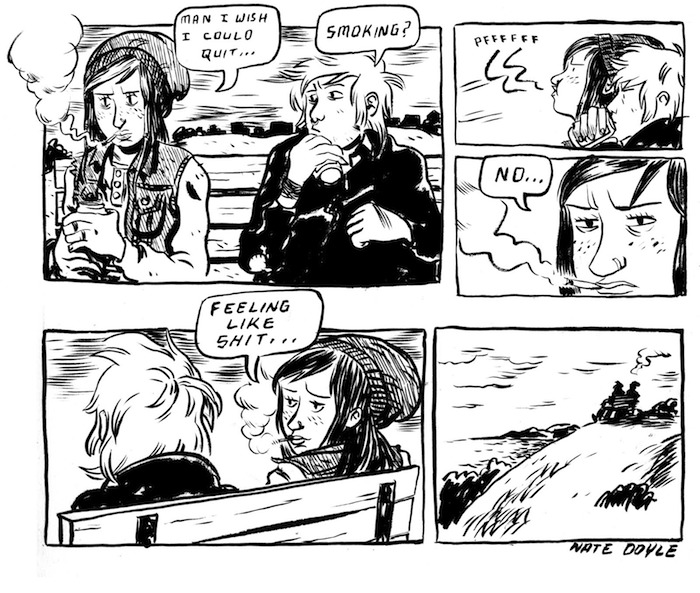
Nate Doyle says that he’s trapped in “a weird purgatory where my art isn’t ‘punk enough’ for punks and ‘too punk’ for comics people.” I’m here to tell you not to be a chump. Nate’s a young dude whose art is progressing at a rapid rate and will soon pass you by. I asked him a couple of questions via email.

How did you get into drawing comics?

I kind of got into drawing comics as a kid. I really liked comics straight from Japan, where I had no idea what anyone was saying but would try and figure out the story anyways. So I would start making mini-comics right onto the folder paper, pamphlet style, and give up about half way through not knowing where the story was going to go, and blow the world up or something. But once I got into high school and started reading Optic Nerve and Nate Powell’s comics I started to think more and make little story doodles and quick comics.

You went to comic-drawing school. What was that like? Do you consider it money well spent?

I went to the School of Visual Arts for cartooning, yeah. That was an interesting experience… The exposure I got to underground, foreign and superhero comics was amazing. I learned so much from teachers just bringing in weirdo artists that I was super stoked on, or having teachers that were weirdo artists themselves who taught me a lot about how to handle or approach comics as a medium and some really helpful techniques. Aside from the school sort of treating the cartooning program as a joke I think it was somewhat well spent. Sometimes I wish I hadn’t gone to school for comics and that I fall into this weird wave of “comics brats” or being seen as something weird like that because I’m a younger artist, but I don’t really feel like I have that kind of comic school aesthetic to my work, which I’m kind of hoping others see as the case, hahah.

Who are some artists you’re inspired by?

Julie Doucet, Bobby Madness, Jaime Hernandez, Blutch, Edie Fake, Ken Dahl, John Porcellino, Vanessa Davis, and Dan Clowes…

Check out Nate’s website at ndcrookedteeth.blogspot.com. He also plays in the band NOMOS.


February 9th, 2011 by Janelle Blarg


Punk Comic History, Pt. 3: Dennis Worden

14 01 2011

If you prefer to get your philosophy from inside a dead dog’s asshole like I do, then you need to know about Dennis Worden. In addition to contributing hilarious comics to anthologies like Weirdo or punk fanzines like Flipside in the early ’80s, he made a variety of minis about some old favorite things, like doing acid in the suburbs, and some unexpected new favorite things, like circus freaks fucking. He’s probably best known for his existential solo comic, Stickboy, about a stick figure that attempts to persevere while being relentlessly peed on by rats or tormented by a disembodied brain. Stickboy had a punk attitude, and although not actually a punk, he was named after Kickboy Face (Claude Bessy) from Slash magazine. Stickboy had a lot of the same experiences Dennis had — choosing to be homeless, living with a cult, working shitty jobs — and basically evolved as Dennis evolved.

The Stickboy comic went through four different publishers, due to various things such as better deals, death and companies folding. Everyone I knew who was into alternative comics at the time was a Stickboy fan. All ten of us. After Fantagraphics, he was published by Revolutionary Comics until the publisher, Todd Loren, was stabbed to death. The last issue of Stickboy was published by Carnal Comics — a porn publisher who had worked with Todd Loren. I’m sure more than a few Carnal Comics customers were hurt and disappointed by the lack of dicks and titties found in Stickboy.

Is Stickboy dead? He may be. At least for now. But even though he’s missed, purgatory seems like a philosophically appropriate place for him to wind up. In the meantime, Dennis has continued his art career doing paintings and shows. Once in a blue moon he still draws comics. Recently he did the cover for a mini of “They Saved Hitler’s Cock” and few panels for a European anthology called Puck. He’s been primarily focused on writing a subversive self-help book/philosophical rant — a more in depth continuation of the philosophical stuff in Stickboy. You can buy art and various merch from Dennis’ website: www.dennisworden.com.

.


January 14th, 2011 by Janelle Blarg


More Comics! Henry & Glenn Forever

22 12 2010

Is Henry & Glenn the most popular punk comic of all time? I think it’s possible. Born on a night when the Igloo Tornado art fraternity had partaken in too many beers and divine revelation struck Gin Stevens:

“There should be a book like Tom of Finland, but with Henry Rollins and Glenn Danzig.”

(by Tom Neely)

The homoeroticism of beefhunks Henry and Glenn has almost certainly been pondered by drunken heads in the past, but only Igloo Tornado had the good sense and drunken dexterity to carry it to the next level and create a series of gag comics about the fantastical life of Henry and Glenn as domestic life partners. The comics first appeared in self-published zine form and have now been collected in a book published by Microcosm.

I asked Igloo Tornado member Tom Neely a couple of quick questions about Henry & Glenn:

(by Scott Nobles)

Do you see this comic series extending into the future or is H&G burnout imminent?

It’s weird when you do a book that’s basically a tossed-off drunken joke and it becomes a huge success that overshadows everything else you’ve done as an artist. At first I was feeling pretty conflicted about that and I was feeling pretty burnt out by it for a while. But I’ve come around to accepting it. It’s nice to make a silly book that seems to make people happy (well, most people anyway — the Danzig fans seem pretty angry about it).

As for future plans… I’m not really a fan of repeating myself, but a lot of people seem to want more of H&G4ever. We don’t wanna get stuck doing Henry and Glenn for the rest of our career, but we might as well ride the wave of success for a little while and have fun with it. We have a couple of other things going on:

I just completed a Henry & Glenn Xmas Special cartoon. That was a lot of fun to make and if I could find a way to do more cartoons, I will. You can see it on here:

And the Igloo Tornado is curating a gallery show of other artists doing Henry and Glenn themed art for a group show at La Luz de Jesus Gallery in Los Angeles for February.

Do you have any advice about how to write a funny gag comic?

Advice? Ha — I didn’t even know I was any good at being funny. Most of my other comics are considered a bit depressing. But I think all great comedy springs from misery. I think all good art, whether it’s comedy or not, should come from a genuine place of self expression. For most of my strips, I mined my own history of dysfunctional relationships to find things I could make fun of. Plus, it doesn’t hurt to get a group of artist friends together with some paper, pens and a few six packs — something funny is bound to happen.

Have either Henry or Glenn seen your book?

Henry has definitely seen it. Gin Stevens got him to sign a copy of the self-published zine version at San Diego Comic-Con back in ’05. He looked at it and said, “Has Glenn seen this? Trust me, he would not be amused.” We couldn’t resist using that as a blurb on the back cover of the book.

Glenn is a different story. About a month after H&G4ever came out, my friend J. Bennett was interviewing Danzig for Decibel magazine. We all signed and gift-wrapped a copy of the book for J. to give to Glenn. We’re all big fans of Glenn, and we really hoped that maybe he’d find it amusing, too. But when J. tried to give it to him, he refused to look at it… and then proceeded to angrily rant about it. J. gave me the transcript of that interaction and I made it into a comic strip. You can see it here… I’d be curious to know if Hall & Oates are aware of the book.

(by Gin Stevens)

Igloo Tornado is: Scott Nobles, Tom Neely, Gin Stevens, & Dino Fucker


December 22nd, 2010 by Janelle Blarg


Punk Comics History, Part 2:
Shawn Kerri’s Not at Oki Dogs

18 12 2010

An Appreciation by Janelle Hessig
from the Punk Comics Issue of
MRR magazine

There are generally three revelations that people experience when first discovering Shawn Kerri:

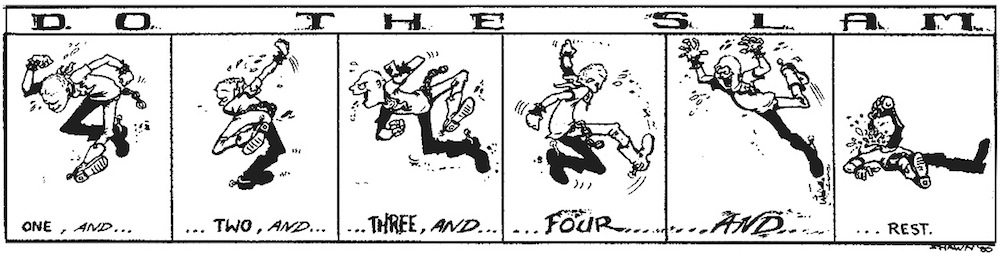
1. The first one is that a lot of your favorite early punk art is all drawn by the same person. I had them safety-pinned to the back of my jacket and so did you. The Germs mohawk skull busting out of the circle? Shawn Kerri. The Circle Jerks skanking guy? Shawn Kerri. The names of other artists from the same era have endured — Pettibon, Pushead, Mad Marc Rude — but, for some reason, Shawn Kerri remains more obscure. She was as prolific as these other more notorious artists and, for me personally, her art resonated more with the things that I like best about punk — action, humor, and being a fucked up kid. So, why isn’t Shawn more well known? One possible contributing factor to her lack of recognition could be that she didn’t fight tooth and nail over copyrights. Around 1986, when the Circle Jerks began pining for mainstream success, their agent and record label decided that they owned the rights to the skanking kid image and shouldn’t pay Shawn. Rather than deal with legal battles and mangled friendships, she just let it go and signed the rights over to Keith Morris. The current day skank kid is a bastardized commercial version of her original art.

2. The second revelation is that Shawn Kerri is not a dude. Born Shawn Maureen Fitzgerald in 1958 near San Diego, Shawn Kerri was a part of the late ’70s, early ’80s Southern California punk scene. During the same period that she was drawing punk flyers and publishing a fanzine called Rude Situation (with one-time boyfriend, Mad Marc Rude), she was also contributing regularly to a multitude of magazines and underground comic anthologies. Among notable publications like (Mad magazine posers) CRACKED magazine, Hustler, and early Last Gasp titles like Cocaine Comics and Commies from Mars, she most consistently contributed to the seminal hot rod and humor magazine CARtoons. During their first meeting, CARtoons’ editor, Dennis Elferson, initially tried to send Shawn Kerri away at the door due to her lacking the Y chromosome needed to draw hot rods. But one look at her outstanding portfolio shut his mouth. Not only was she skilled at drawing muscle cars, she was also into driving them and owned a ’57 Chevy Bel-Air (which she used to drive her band The Dinettes to the infamous Western Front festival at the Deaf Club in San Francisco in 1979).

Comics, punk, and cars — all heavily dude-dominated domain and Shawn Kerri ruled them all with her superior art. Although her drawing style is actually kind of conventional in certain ways, with her use of hard black lines and anatomically straightforward characters, her drawings still convey the rawness and wild vibe of some looser, more stylized cartoonists. This is due in part to dynamic posing and the frenetic details that always make her comics come alive with chaos, violence, and fun, like a gutterbound Jack Davis, but it’s also due to something more intangible, an essential genuineness.

3. The third realization is that Shawn Kerri is dead. No, wait — she’s alive! No, sorry, she’s dead. No, wait … There has been decades worth of chatter about whether or not Shawn Kerri is dead, with people on either side of the debate swearing first or second hand knowledge one way or the other. Spread all willy nilly across the internet, there are people who claim she OD’d in the late ’90s (including credible sources like her former CARtoons colleague, George Trosley) and then there are alleged sightings of her like she’s a goddamn Bigfoot, people claiming to have hung out with her on the beach and so forth. On the Gig Posters message board, one thorough-as-a-motherfucker Nancy Drew wannabe claims to have searched the US Social Security death database in ’09 and did not find a Shawn Fitzgerald or a Shawn Kerri listed as deceased. Of all of these accounts, the one that rings the most true to my ears is from Carl Schneider, who did a magazine called Black Market and is currently making a documentary about Mad Marc Rude. Apparently, Carl went to Shawn Kerri’s mother’s house around 2004 and found Shawn there. The story is that she is battling horrible health issues—the most serious being severe brain damage from a spill down the stairs and that she is not really there any more and can scarcely communicate. Is it true or just another Bigfoot footprint? I say it’s probably true, although it would be nice to believe otherwise.

I don’t know that there is anything I could say to do appropriate justice to her legacy. There are a lot of other stories to dig up about Shawn Kerri that I haven’t even touched on — including her working on boats, being a junkie, and a story from Fucked Up & Photocopied where she pulled a sword out of her trunk to fight some skinheads. Extreme rumors are the hallmark of a bone fide bad ass and among all of the stories about her, it’s only right that Shawn Kerri should have the last word here:

“I’ve never gotten the same thrill out of having one of my cartoons printed in a magazine as much as seeing one of my old fliers — something I did for a punk gig the week before — laying in the gutter. Seeing it all mashed and dirty thrilled me, because that was how I was living, too. It looked exactly like my life.”

—from Paul Grushkin’s Art of Rock book


December 18th, 2010 by Janelle Blarg


Punk Comics History, Part 1:
Comical Funnies and Stop! Magazine

12 12 2010

Hey, it’s a new comics feature here on MRR.com by Janelle Blarg — just in time for the Punk Comics Issue of Maximum Rocknroll magazine! Tune in for more from Janelle in the weeks to come…

Comical Funnies was a newsprint comics fanzine started in 1980 by John Holmstrom (of Punk magazine and Ramones art infamy) and Peter Bagge (whose ’90s era Hate comic was about the best comic series ever). The late ’70s/early ’80s comics scene in New York was a breeding ground for great cartoonists. Perhaps this could be partially attributed to the fact that many of them were attending the School of Visual Arts, where the late, great Harvey Kurtzman (Mad magazine founder) was teaching at the time. Or maybe the drugs were better then.

Whereas Art Spiegelman & Françoise Mouly’s RAW magazine (also started in 1980) served up a more intellectual, highbrow brand of comic art, Comical Funnies dealt more in the getting-wasted-in-the-alley-and-telling-dick-jokes-with-your-friends brand of comics. You know, comics that were actually FUNNY. But the art was also top notch. No scribble scrabble here, folks. People like Ken Weiner, JD King, Kaz, and Drew Friedman made this a classic.

After one year and a mere three issues, Bagge went on to take over as editor of Last Gasp’s Weirdo (after R Crumb left) and Holmstrom started up Stop! Magazine with JD King, Bruce Carelton, Dale Ashmun, and others. Both of these successors had a very similar vibe (and many of the same contributors) to Comical Funnies.

LINKS:
John Holmstrom’s website

Peter Bagge’s website

The covers and some of the art of Comical Funnies can be found on Bruce Carleton’s website


December 12th, 2010 by Janelle Blarg