Book Reviews

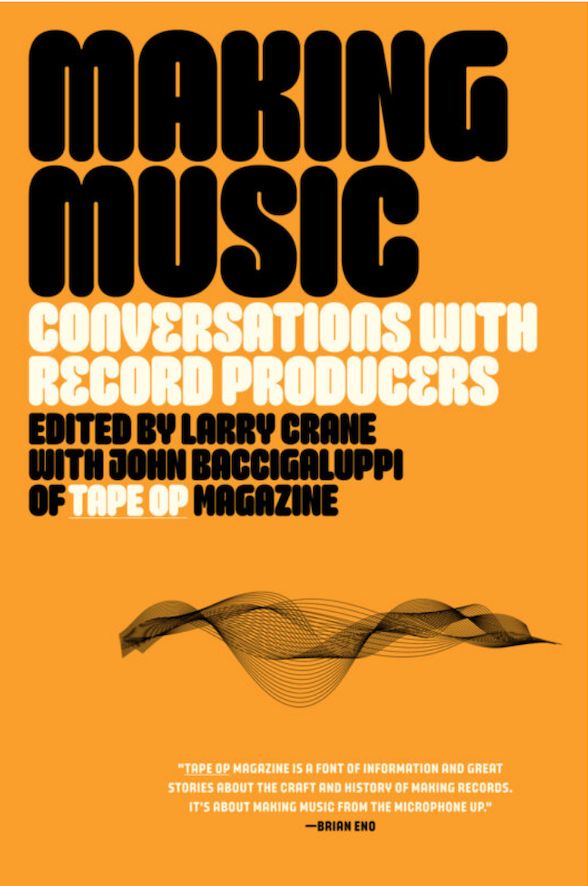
Making Music: Conversations with Record Producers John Baccigaluppi and Larry Crane

My first encounter with the Tape Op universe happened when I picked up a magazine that was laying around Mike Pack’s studio, Revolution Sounds, in Chattanooga, TN. This was twenty-plus years ago. Listening to LANDLORD track “More Trouble” on Beneath the Wheel, and being frustrated that they didn’t do the ending phrase twice. I was stuck flipping through the pages of Tape Op. In those pages, I quickly came to see my core belief, that:

Music is a foundational tenet of human expression, and that gate-keeping, gear fetishism, and egoism—used as a way to exclude others from the necessary expression of their existence, and the resultant suppression, by these means, of the full and radiant blossoming of that existence will all eventually be viewed by any modern society in the same primitive, idiotic, and old fashioned light as which we now see racism

 is not universally shared.

So, sitting on a tweed couch in a hot-as-hell DIY studio back then, it was with significant trepidation that I looked past the slick, full color ads hawking the gear that will make you famous. I looked to the interviews with the bands, the engineers, producers, and other peripheral people in the music industry. That was a good choice. The interviews in Tape Op magazine are generally stellar. They rarely fixate on gear, but instead really dig into the creative process and philosophy that people bring to the craft of capturing recorded audio. 

Making Music is a collection of interviews from Tape Op that focuses on the role of the producer, and for anyone even slightly curious about the history of the hits, it’s well worth the read. The LEE SCRATCH PERRY interview is some of the most enlightened…deranged…I can’t tell…thinking that I’ve read in a good long while. And hearing LINDA PERRY (no relation, ya dweeb) recount a songwriting session with DOLLY PARTON (R.I.P.) where DOLLY’s assessment that she was “weird, but I like you” felt right. 

And while there are a few interviews with modern-ish producers, most of the content focuses on the anachronistic producer. The canonical quirky person who can play everything, compose, engineer, mix, inspire, but most of all knows when to get out of the way. I didn’t know many of the names in this book, excepting some of the inescapables (RZA, Glyn Johns, BRIAN ENO). But I certainly knew the songs they helped to birth and the artists who birthed them. 

You’ll read stories about the REPLACEMENTS, PRINCE, BOWIE, WU TANG, all of the Def Jam crew. This book contains anecdotes and reflections on the playlist of American and British commercial music over the last 50–60 years. It’s pretty darned interesting. But, it is also a tacit embrace of the music industry and all of its flaws. There’s just so much fucking money in it that the corrupting influence of commercial interests unavoidably trickles through many of the interviews. That isn’t to say that the producers highlighted in this book were just looking for the next cookie-cutter hit. In general, the interviews tell a wholly different story. They focus on musically obsessive people who dig in so deep that they are able to form exceptionally well-informed opinions on the choices they make as they work. These interviews reflect intellectually curious, technically astute philosophers of music.

If you’re interested at all, the interview with Susan Rogers alone was reason enough to create this book. She was PRINCE’s engineer and producer from 1983 to 1988, so yeah. Purple Rain, Around the World in a Day, Parade, Sign o’ the Times, and The Black Album. PRINCE probably would’ve been PRINCE without her, but I don’t think as much of it would have been captured. She worked 25 hours a day to unleash that beautiful man upon the world, and tells us about it in Making Music.

Last Night at the Lusty: Remembering San Francisco’s First Unionized Strip Club Janelle Blarg

Last Night at the Lusty: Remembering San Francisco’s First Unionized Strip Club is a fascinating expose of North Beach’s most notorious haunt. Filled with shocking twists and urban legends (but are they?), Janelle Blarg’s most recent comic also highlights the risks, the racism, and the management’s reluctance to address many of the employee’s workplace concerns. Blarg exposes the ongoing issues that eventually resulted in the dancers forming a union with the SEIU; theirs famously becoming the first strip club in the United States to do so. Last Night is a wonderful read, celebrating the women of the ’90s in a true tale of sticking it to the man while simultaneously making San Francisco history.

Alternative Voices: 1980’s Punk San Francisco Photographs by Jeanne Hansen • Interviews by Jonah Raskin

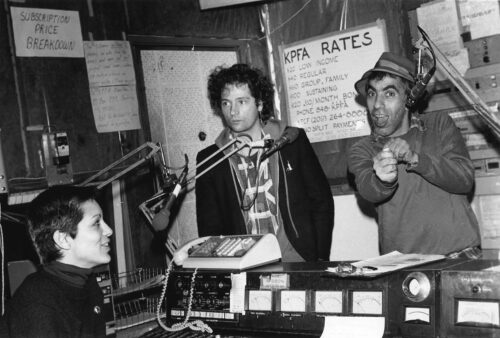
While working on the Murray Bowles photo book, I found myself in an early ’80s Bay Area punk frenzy, gobbling up old photo books, zines, and newsprint rags of the day, and digging into internet rabbit holes left and right. Along the way I came across this gem, self-published in 2021, which I immediately needed to obtain at the very least for the great shot it contained of Tim Yohannan, Ruth Schwartz, and Jeff Bale in the KPFA studio during a Maximum Rock & Roll (sic) Radio broadcast in 1983. I was stoked, upon receiving the book, to find so much more of interest…

MRR Radio on KPFA: Ruth Schwartz, Jeff Bale & Tim Yohannan (photo by Jeanne Hansen)

Featuring photos taken between 1980 and 1986 and testimony from 16 of the featured subjects, Alternative Voices offers a unique view of the early SF punk scene as it was experienced through the lens of photographer Jeanne Hansen and the people in her orbit.

Upon my first flip through of Alternative Voices, I was reminded that the punk scene isn’t, and never has been, all about punk rock. The scene, especially in SF in the early ’80s, is a grand collage of all kinds of freaks and weirdos doing all kinds of cool, creative shit. I appreciate how Hansen gives it all equal weight here. Bambi Lake, the Looters, the Club Foot Orchestra, Survival Research Laboratories, the Sisters of Perpetual Indulgence, Code of Honor, performance artists, poets, visual artists, political activists, experimental musicians, drag performers, and the Space Lady can all occupy the same book without anyone having to explain exactly what their connection is. The connection, of course, is that they were all bubbling out of the same post-hippie, Carter/Reagan/Feinstein-era counter-culture, trying to make something new and vital.

While punk photo books most often focus on bands on stage (and there is plenty of that here) the most compelling part of Alternative Voices is that we get to see punks in their natural environments: Code of Honor practicing at Subterranean, the MRR crew on the air at KPFA, flyer artists making and putting up their work (plus, honorable mention to the neighborhood vigilante removing flyers— ey, they are part of our history too!), bike messengers, and cab drivers…we see punks drawing stares in the street, punks covered in frosting, punks loitering after work, and a single punk observing a dead rat suspended from a street sign. The topper is the cover shot—our lone, leather-jacketed punk, Stanous Flouride, descending the BART escalator surrounded by downtown SF commuters. A classic photo that almost feels staged because of how era-appropriate it is.

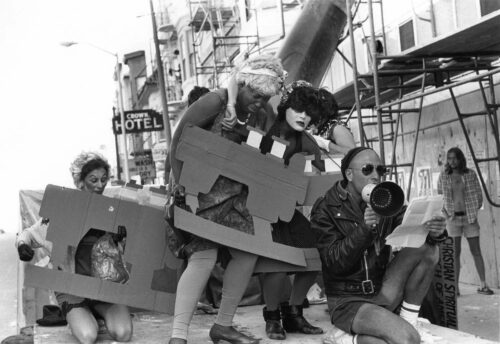
Urban Rats Street Theater Protesting Sweatshop, Valencia Street (photo by Jeanne Hansen)

Jonah Raskin’s interviews, edited into concise one-page essays from sixteen of the subjects, pepper the pages of Alternative Voices. Offering distinctive perspectives, they give the book the feel of a documentary film, allowing you to enter a world, rather than just observe it. We hear what brought people to SF from far and wide, and how they each helped the scene find its footing. While there isn’t a strong narrative connecting all of these people and activities, the interviews give context and background that amplify the importance of the photographs themselves.

This book is worth seeking out even if, at first glance, it doesn’t seem to contain everything you’re hoping to find. If you’re looking for a comprehensive photographic history of San Francisco punk, this isn’t it. But it’s not trying to be. Alternative Voices reminds us that history isn’t actually the neat collection of names and events that everyone comes to know. There are always thousands of things happening outside the frame. Jeanne Hansen happened to have a camera pointed at some of them. And I’m glad she did.

ESTA BOCA ES MĺA Lupita Limón Corrales, translated by Alexia Veytia-Rubio


ESTA BOCA ES MĺA is a bilingual book of poems that are pointed toward faith in solidarity. Corrales’s poems tell stories about tenant struggle, misogyny, and acts of anti-imperialism—also about karaoke, romance, and comradeship. The book is illustrated with photographs from the neighborhoods in Los Angeles where the poems take place. Within many of these poems are snapshots of tenant nerve: A mother moves into a party supply store. A widow shakes her husband’s ashes along the doorway of their house that’s been put up for sale. Someone picks church roses and is admonished to hell by a neighbor—before a nun interjects that “The roses belong to everyone…” (Heaven’s Green Lawns)

Corrales works with LATU (Los Angeles Tenants Union), an organization that organizes tenants to fight evictions and build tenant associations. Tenant associations are formed around a building, a common landlord, or a neighborhood to organize strategically against harassment, neglected habitability issues, evictions, and displacement. Lupita is focused on language access across the organization.

These poems are wise to the long arc of hostility on inhospitable lands. “In this war against living, I take my position on the side of eternity” (Divinity’s Guests). Una Boca mentions many people whose strength rings through Corrales’s work: Leila Khaled, Emma Goldman, Daisy Zamora, Saint Teresa, and Saint Vibiana. The locus of these poems reach from Los Angeles to Gaza to Mexico, invoking the lineages of saints, poets, and anarchists engaged in class struggle against those who control “Bulldozers and fences [that] terrorize the poor”—and those “against children…olive trees…bakeries, libraries and poetry.” 

Her poems are romantic and spiritually salient, though grounded in material conditions: “Every time a laundromat closes / the property value goes up…” Her work addresses the imbalance between the prioritization of real estate and the quality of our lives. Her voice speaks with strength from a life-instinct within the tenant struggle, in line with her judgments: “…Even in hell the jasmine still blooms / and the sun shines on each of us / whether we deserve it or not” (Old Linens). 

The title ESTA BOCA ES MĺA refers to an incident where the author was banned from karaoke at a bowling alley. Alexia Veytia-Rubio translates: “I’m a conduit just like a mic. This mouth is mine/and it never stops screaming.” The night out is in celebration of solidarity: drinking palomas, a widower singing to his deceased wife, a friend smashing a glass in support when she is kicked out of the bar.

Corrales writes about working with the Mohawk Street Tenants Association in Echo Park, which successfully organized to legally ban “Renovictions.” Renovictions are a method of gentrification in which landlords displace their long-term tenants to remodel their properties and hike up rents. Corrales’s poem QUERUBIN/MOHAWK STREET is about helping Memo (a Mohawk Street tenant) fight an eviction after he is laid off from his job in a cherub factory that he had worked for decades. The poem contains both factory cherubs and angelic encounters. His daughter Lulu learns strategies for door-knocking at church and uses this skill to bring tenants together, sharing information about their housing situations with each other. Lulu asks a neighbor: “A quien le tendremos miedo, / si hay solo un juez?” Questions of materiality, privatization, and displacement become divine, angelic, and existential. The poem ends: “We pray to love the angels more / than we fear the devil. Then / we see the angels everywhere.” 

Strategizing against a common class enemy can breed resentment. Navigating the city’s bureaucracy—burnout, breeding malaise rent-free, like bitter fruit flies in the head. Yet these poems reignite our quicksilver and are not disheartened by the work.

All Roads Lead To Punk – BOOK + 7″ record set Genny Schorr

I thought all the stories had already been told, or at least endlessly circled, (like a clogged toilet) with regards to the early days of the LA underground music scene. But I was wrong. At that point in time, the early to mid ‘70s, punk wasn’t widely accepted as a thing to be, but Genny Schorr’s attitude and actions were entirely punk. Genny’s storytelling is laid out like an old telephone cord; wound into pliable circles that stretch and contract. While the narrative is linear, the chapters overlap and connect. Genny takes you back to the beginning, like the beginning for most of us, when a friend took you under their wing and she rolled you through her life of impulse with her, “why not me?” mindset that collided headfirst into right-place-right-time opportunity.

This book-and-record combo isn’t entirely unlike those from our youth. Remember the book and record sets that would beep to tell you when to turn the page? This one offers a more modern twist: sprinkled throughout the pages are QR codes that direct you to songs reflecting the recording sessions and stories written in the book. Beyond the drugs and the sexual encounters, including one threesome with someone from the JAM, this book leans into a deeper theme that’s often missing from other accounts of the era: lifelong friendships. There isn’t a song tied to the JAM sex, at least not explicitly, but there are songs where Genny has the BOYS(UK) as her backing band.

Filled with accounts surrounding friendships with the GO-GOs, the BANGLES, X and EXCENE, ALICE BAG, and many others, there are several unexpected turns in her life path. There’s the heartbreak of friendships falling apart, unbalanced love, and dreams dying. The book also captures the opposite of all that as well. I don’t want to spoil her story by melting it down to the juicy plops, but I do need to touch on the band she was (and is) part of, BACKSTAGE PASS. Genny’s band found themselves opening or headlining for what, by today’s standards, would be considered genre-defining bands, though at the time, they were simply friends and peers sharing the stage, like the WEIRDOS, ELVIS COSTELLO, WALL OF VOODOO, DEVO, and many others. BACKSTAGE PASS undeniably made a crater in the LA late ‘70s underground scene.

I’m only going to touch on the music dollops and leave some of the larger twists for you to discover on your own. Parts of the book mirror so many of us and our excitement while waiting for touring friends to come through town, to moving into adulthood and losing touch with those same friends. All Roads Lead to Punk is a twisting pothole ridden ride, made tolerable by kinship and astounding landscape that undoubtedly leads to the dead center of punk.

FROM THE BELLY Emmett Nahil

From the Belly is a wicked tense tale braided with fate, legacy, and wonder. The writer, Emmett Nahil, is a New Englander who cofounded a video game company called Perfect Garbage Studios. Nahil is a horror and speculative writer and artist. On the periphery of the writing is a historical, queer, and rhythmic atmosphere that bodes well for a soundtrack. Some of the songs on my list for this book are “I Must Not Think Bad Thoughts” by X, “Dreams” by DESCENDENTS, “The Ocean” by AGAINST ME! and “Search and Destroy” by the STOOGES. 

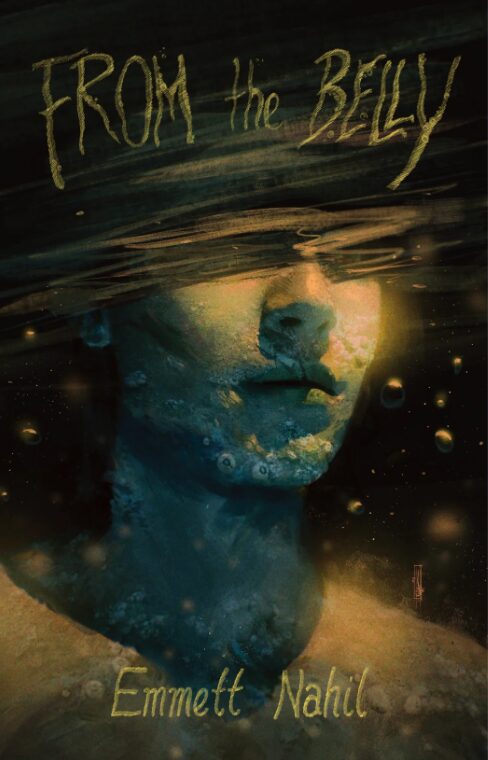
The outside cover is designed by Chris Shehan, a comic book artist with expertise in the horror genre. The art exposes the weird sensation the reader can glean of what it must be like to be on the ship as it transforms throughout the story. The visual pulls through what Nahil conveys through his protagonist: to be in this place, with this directive to kill whales is unsettling and destructive. The book is peppered with rich illustrations by Megan Llewallyn, a medical and comic book illustrator, which gives even more depth to the body horror and makes the most poignant and transitional scenes erupt from the page. 

Nahil’s story asks the question: What can one do when their past, present, and future all haunt them with the heart thumping pressure of inevitable death? Isaiah Chase, a crew member on a whaler ship named The Merciful navigates this question as the horrors persist and take over with each turn of the page. Isaiah stumbles through his journey in a haze. His surreal and dark dreams are something his father suffered with as well. Isaiah worries he’ll fall into the same traps his ancestors did. The book ponders: will he ever be able to understand his lineage? Does anyone? (As a human, this is something I ask myself often. Even if Isaiah did have all the answers of his father’s experience, could it be fully understood?)

The dangerous reality is that the profession of hunting whales puts all the characters at risk of fighting the vast sea and losing everything. Even without dreams, there could be a gnawing feeling that something just isn’t right onboard the ship as storm clouds for Isaiah and the crew approach from all directions. The most powerful and thrilling moment is when Isaiah collides with the namesake of the book, a man who is discovered in the belly of the whale. The crew discovers this still-alive man, and it stays a true pleasure for the reader each moment Isaiah draws near him. The man has explosive presence and control while being shrouded in mystery that causes apprehension in anyone who crosses his path. 

Isaiah and the man are drawn to each other. They want to save each other from their fates. The man may know it is foolish though, and says to Isaiah, “Men don’t change. Only grow to be more so who they always were under the skin.” As Isaiah continues to swallow down his reality with delusional optimism, a reality where he and everyone on the ship can survive, the mood aboard the ship shifts. The moody, salty, sea changes the crew and its captain from the inside out.

The connection between Isaiah and the man from the belly of the whale coupled with the atmosphere, are the best parts of the book. An aspect of the book that might frustrate a reader is the number of characters that are never known in depth. While it makes sense to have many crew members on a whaler ship, the use of names can get confusing and distracting when the biggest known significance of each character is what their role on the ship is (possibly, in part thanks to the capitalistic society for the brainwashing of people’s worth being in their work) without many grounding characteristics to differentiate them.

Another nitpicky gripe is the number of adverbs (many writing mentors harp about avoiding adverbs). The descriptions sometimes lose their flow, and it causes a neurotic urge to edit them out of the copy in my hands. “…Isaiah had the sense that he was telling him half-truths, that there was something slightly off kilter. But this was the first time he seemed truly contrite…” Though that could just be me, and despite these things, I do think the man in the whale redeems the glares of the -lys and keeps a hook into the reader to want to see the scary yet juicy connection play out.

HAIL MURRAY! THE BAY AREA PUNK PHOTOGRAPHY OF MURRAY BOWLES 1982-1995
Edited by Anna Brown

Punks of the pre-internet age were good at sleuthing out information, tracking down new bands and finding meaningful connections between seemingly disparate groups of like-minded maniacs. My friends and I in the deep south, far away from coastal cultural meccas (insert RANCID quote here), traded notes about our hours spent pouring over liner notes, thank you lists, record label catalogs and photo credits. We made our own lists of the names that seemed to pop up over and over: Biafra, MacKaye, Vaucher…we cross referenced, dug deeper, looked west and further underground. MDC, MINUTEMEN, SEWER TROUT, OPERATION IVY, CRIMPSHRINE, NEUROSIS, BLATZ. The more we searched, the more we kept coming up with the same name: Murray Bowles. Seeing his vibrant photos helped us feel connected to something bigger than ourselves and showed us kindred spirits in places that felt worlds away.

Shockingly, Murray Bowles has only had one other collection of his work, in the MRR-published photozine from 1986, If Life Is a Bowl of Cherries, What Am I Doing in the Pit? Before his untimely death in 2019, he had started sorting out photos from his massive archives to make this book with his friend and editor, Anna Brown. After his passing, Brown grieved and moved forward with a small crew, combing through the archives to find essential shots that would help to tell a fuller story of the kind of Bay Area punk that Bowles championed throughout his life.

Murray seemed to be everywhere that cool stuff was happening in the Bay and this collection of his early work confirms that. From the Mab to the Vats to Gilman Street to infamous punk houses to donut shops to nameless warehouses and everywhere in between, Murray was there with his camera held aloft. Hail Murray! shows that he was often directly in the middle of the action, inches away from a boot to the face, or worse.

The book is laid out beautifully by Paul Curran. Unlike some other collections I’ve seen recently, it has a very clean look and doesn’t seek to overwhelm the reader with a sensory overload. Brown and Curran clearly exhibit a lot of love for Bowles’ work and many of the photos stand alone, so that you can really immerse yourself in all of the details of every image… and there is a lot to take in! It’s easy to get completely lost in every shot. I feel like each photo in here tells us a bigger story, answers questions, asks many more and even challenges assumptions we’ve all probably made about punk throughout our lives. Why does the singer of RIBZY have a cast on his arm? MINOR THREAT played in a basement on Valencia Street?? We already knew that the FEEDERZ threw a dead dog into the audience at Gilman, but did we need the photo of it? (Yes, we did). If all the old heads always talk about how the original hardcore scene was so dangerous and insane, why are people sitting on the ground during the MDC show? Who the hell is ELECTRIC SPAGHETTI?

SPECIAL FORCES, University of California at Berkeley, 1985 (photo by Murray Bowles)

The eye-opening introduction pointed out many facets of Bowles’ life that I was never aware of. Without giving too much away, Aaron Cometbus pens the kind of foreword that you always wish was in these larger punk retrospectives. Instead of securing the red velvet rope that leaves you outside of the party, he opens the side door to usher you in, pressing his still-wet stamp to the back of your hand. A rare interview with Murray from 2010, conducted by Brown and Cometbus is also included, which produced my only criticism of the book, albeit tiny: for the eternally curious, they never ask what kind of camera or film Bowles used during this era of his life (the answer: it was mainly a Nikon FE2 with a 28mm f2 lens and direct flash on Tri-X film exposed at ASA 400. Later, a Nikon N90).

Murray stayed with us in the underground because it was more interesting and exciting than the shows in larger venues. The book captures this with his candid shots from front yards, punk house kitchens, dogpiles on couches and smiling kids hanging out in the street. It shows the scope of a vibrant scene, documenting the interconnectedness and lack of barriers between audience and performer. He was much more interested in the unknown faces peeking out of the shadows or the new band opening the show than the crowd favorites. He showed the innate joy of punk and friendship. Until the very end, Murray documented the DIY punk scene with dignity, respect and a palpable love for the lives he captured in his lens.

I don’t envy the colossal task of sifting through his thousands and thousands of film negatives that he left behind, looking for the perfect shots for this book. I’m sure that the chorus of opinions about who or what should be included were sometimes deafening, but Anna Brown and her crew did an outstanding job with the parameters that they set for themselves. By approaching this in the same respect and eye for detail that Bowles graced his photo subjects with, Brown has created an astonishing and essential testament to the importance of Murray’s legacy to share with us all.

Stagediver, Youth Brigade show, San Francisco, 1983 (photo by Murray Bowles)

One last thing before I go. Like most good stories, I heard it third hand. As it goes, some young punks, way out in the suburbs of the South Bay in the 2010s, booked a show in their friend’s garage. On the day of the show, the turnout was very low… hardly any more people than the bands and a few of their friends. They were feeling dejected and unsure of everything. Guess who walked through the door in that moment, smiling, camera in hand? Just like that, they felt like something bigger than themselves. A continuation of the thread. Kindred spirits in worlds that felt closer than ever. They were a part of the ongoing story through Murray’s lens, and it meant everything.

There is Nothing so Whole as a Broken Heart: Mending the World as Jewish Anarchists Edited by Cindy Milstein

On October 27, 2018, an armed white supremacist entered the Tree of Life synagogue in Pittsburgh, Pennsylvania, proclaimed “All Jews must die!” and proceeded to kill eleven people and injure six others. This event caused many radical Jews, including myself, to rethink their relationship to Judaism and Jewish culture. Suddenly, the threat of fascism and anti-semitism wasn’t historical or theoretical; it was right down the street. To be a Jewish person on that day was a shitty, lonely feeling. I remember crying in the bathroom at my restaurant job, the only Jew on staff, watching couples and families continue to happily eat brunch as though nothing had happened, as if no mass murder had just been committed in our city. 

American Jews occupy a precarious position in the United States today. We are considered American until the horrifying moments when we aren’t—until white supremacists in Charlottesville are shouting “Jews will not replace us!,” until swastikas are painted on our cars and on our schools, until our headstones are knocked over and smashed in our graveyards, until the word kike is muttered, until our Chabads are set on fire not once but twice within one week, because someone decided they were not adequately eviscerated the first time. 

Anarchist, socialist, communist, leftist, feminist or otherwise radical American Jews occupy an even more dangerous and fraught position. We are forced to contend with the very real threat of anti-semitism (often from within radical communities) while also dealing with rejection from our Jewish families and communities because of our solidarity with the Palestinian people and anti-Zionist views, our queerness, our politics. We are constantly asked to answer for Israel’s government when we believe in neither Israel, nor governments. We carry the weight of centuries of intergenerational trauma and negative stereotypes, including the model minority myth that has most Americans convinced Jews are all wealthy and privileged, obscuring the lives of poor and working class Jews. Those of us who are Jewish and radical often find ourselves being asked to choose between those two identities, with the underlying assumption that they cannot coexist. 

In the midst of these painful intersections, There is Nothing So Whole as a Broken Heart: Mending the World as Jewish Anarchist emerges as a powerful offering and testament to survival, solidarity, and the ability to envision and create radical Jewish communities. It is a text for the outcast Jews, the ones you never see portrayed in the media—BIPOC Jews, trans Jews, punk Jews, Jews who know only a smattering of Hebrew or Yiddish, Jews who never had a bar or bat mitzvah, Jews who have been told they are not Jewish enough or too Jewish, who never went on a Birthright trip, Jews with a complicated relationship to their Jewishness. There is Nothing So Whole as a Broken Heart attempts the difficult work of connecting people across diaspora through their resistance to WASP, colonial, patriarchal systems. 

 Although the contributors come from a variety of backgrounds (not just American—some are also from Canada, Australia, and elsewhere, and not all are explicitly anarchist), there are many common threads throughout the book. These include: empathy for the struggles of other oppressed groups worldwide, police brutality, grief and mourning, the experience of the Shoah (Holocaust), Jewish resistance to fascism, the necessity of ritual, diaspora and the search for a sense of belonging, the use of food and music as tools of revolution, collective organizing, and the reclamation of Jewish creatures like the golem and dybbuk as symbols of transgression. Throughout, there is an insistence that radical Jewish traditions are not in conflict with Judaism, but rather continuing ideals communicated in the Torah. Resistance, mischievousness, and struggle have always been a part of the Jewish mindset. One of the greatest accomplishments of There is Nothing So Whole as a Broken Heart is that it situates modern Jewish radicals within a lineage of Jewish radicalism, from Yiddish anarchist anthems like “Daloy Polizei! (Down with the Police!)” to Jewish folktales about women who dared to refuse the demands of kings. 

Standout pieces in the book include Ami Weintraub’s “How to Scream, How to Sing,” about their experience working at the Tree of Life prior to the October 2018 shooting and starting the collective RAYJ (Rebellious Anarchist Young Jews) which sets the tone of the anthology, and Cindy Milstein’s heart-wrenching essay with the deceptively benign title, “Anti-Semitism Hurts,” which details Milstein’s encounters with anti-semitism both in anarchist circles and as a Jew living in the Midwest. These incidents culminate with Milstein’s German swimming partner casually uttering the phrase, “It’s hot as a gas chamber in here,” in reference to the swimming pool, then trying to defend herself by saying it’s a commonly used phrase in Germany. In the end, Milstein concludes that the issue is not really that anti-semitism offends Jews, but that the mindset behind it is linked to the literal deaths of Jewish people. Almost every piece in the anthology speaks to legacies of trauma and suffering, which I suspect is why Milstein wisely breaks the text up with sections of art, allowing readers time to digest what they’ve read. And the art is no afterthought here—the woodcuts, collages, and comics are stunning and could easily make up a book by themselves. 

My favorite section was entitled “Resistance as Repair, and gives examples of Jews engaged in activism that combines their anarchism and Judaism in thoughtful and creative ways. Examples include: a Jewish drag troupe, a Jewish anarchist radio station, a volunteer taharah collective (taharah refers to the Jewish ritual purification of the dead, and this was an amazing reflection on the treatment and care of the deceased), and the creation of a radical Jewish calendar that rejects Christianity’s time structure. We hear from countless voices of anarchist Jews doing meaningful work in their communities, working with Jews and non-Jews alike to build a better future. In the face of so much hatred, these stories offer tangible hope. 

There is Nothing So Whole as a Broken Heart would have benefited from the perspectives of more BIPOC, Sephardic, and Mizrahi Jews, and more writing about Jewish culture’s relationship to whiteness in general. Perhaps this is as good a reason as any for a second anthology. There is much more to be said about the convergences of Jewish tradition and radical liberationist thought. But I am grateful to Cindy Milstein, AK Press, and all the contributors to this anthology for starting such an essential conversation. 

To Live and Die on Zug Island Ryan Bartek

To Live and Die on Zug Island is a memoir of author Ryan Bartok’s formative years in the rough and tumble world of ’90s Detroit. A sort of magnum opus for Bartok, this book was written over an 18 year period with drafts separated by decades of experience and maturity. 

Fashioning himself as a punk rock Jack Kerouac (that’s obviously Aaron Cometbus, but okay), Bartok takes the reader through grimy streets filled with gang violence, drug abuse, and a cast of very colorful but rarely relatable characters from his neighborhood. 

Early on, he writes, “Any critic in the way gets bulldozed.” Well, I guess that’s me. This book is fucking terrible. What could have been a fascinating snapshot of American life in the last era before the Internet changed life for everyone, we get meandering ramblings from a truly unlikeable person who seems to be daring the reader to put the book down on every page. Not only is Bartok his own biggest fan, this collection of self-aggrandizing tales goes nowhere and is frequently confusing and pointless. Add to this some of the most overwrought, overwritten prose that has ever been painted purple, and you have a chore to slog through rather than a book to read. 

For example, consider the following passage: “You are about to read the lives of 100 men — no consistency save for a consistency of dueling opposites. In their freedom of shapelessness, thoughts liberate & confine… Philosopher, assuredly — though tongue in cheek; Poet, certainly, but as a desideratum dermabrasion born posthumously into an antiquated age of mongrels.” What does that mean? Who cares? I’m sure it sounded great to the author in his journal, but imagine over 300 pages of this self-important musing. Also, nearly every single page has numerous grammatical and punctuation errors. It is a stream of consciousness that could use a filter.

Even when Bartok gets close to relatability, he ruins the moment by inserting a sardonic edginess into the proceedings. For instance, when his beloved grandmother is near death after a battle with cancer, he writes, “Grandma was in the last 10 minutes of her life, and mustered the strength to give me one last smile. This sickly deathbed smile, blackened gums, bleeding teeth…” His desire to come across as edgy, tough, and emotionally impenetrable makes him less the anti-hero he wants to be and more a damaged and off-putting asshole. 

I could run through more of these disconnected episodes, such as the one where Bartok and his buddies react to the 9/11 attacks by hopping in a car with katana swords (really?) and driving through the predominantly Arab-American suburb of Dearborn, or maybe the one about the church his friend wants to start at raves where everyone takes communion of MDMA and worships house music, but what’s the point? These stories have no thematic connection and are just vehicles for Bartok to show how much of a misunderstood “bad kid” he is. While disjointed collections of vignettes like Kerouac’s On the Road or Irvine Welsh’s Trainspotting can stitch together a time and place with rich detail, this one does not. Despite all the attempts at transgression and darkness, the book is never relatable enough to create an impact.  

This brings me to the passage that completely lost me. Bartok describes a game that he and his friends used to play called “N—–” (as in the racial slur, repeatedly appearing unedited and in all caps in the book). He describes it as a sort of a human fox hunt where “If caught within 15 minutes by the Slave Hunters’ the N—- would have no choice but to take in exactly 2 minutes of full-blown lynching.” Now, I did stupid, insensitive shit as a kid. You did stupid, insensitive shit as a kid. But I never engaged in cruel games that belittled the horrors of slavery. And, if I did, I would not casually throw the story around today as an amusing anecdote of a simpler time. Unacceptable. It’s this sort of urge to offend, to stare down the reader and demand (apologies to SSD), “How much pretentious bullshit can you take?” that led me to close the book and not look back. I wish Bartok peace because he is more troubled than he lets on. And if he decides to write another book, I hope he hires a goddamn copyeditor. 

The Last Book on the Left Ben Kissel, Marcus Parks, and Henry Zabrowski

I will preface this review by saying I’m a pretty big fan of The Last Podcast on the Left. I’m listening to an old episode about the “Satanic Government” as I write this. 

I’ve been listening to the show for a few years now. At first I found them very irritating. 

The podcast covers all the weird and strange things. Serial killers, UFOs, cryptids, curious characters and events (L. Ron Hubbard, The Mormon Church, The Donner Party, Madame Blavatsky, etc.) among other topics. 

Information is poured through a strainer of comedy and hosted by the following authors. Marcus Parks, who wrote the majority of this book, tells the story and comes off on the show as relatively serious. Henry Zabrowski is a comedian and actor, who does characters in relation to the story and does his share of research for each show. Ben Kissel generally serves as the audience’s stand in. He seems to know nothing of the story and tries to fit in some levity for some of the darkest corners. 

It took me a few episodes to crack a smile. Especially in the early episodes there is a “bro” aspect to the show that really turned me off. But the topics fascinated me and I kept listening. As the years have gone on they have mellowed and some of the rougher edges have been shaved off. The stories themselves are just as gruesome or terrifying as they ever were, and they’ve become better storytellers. 

The Last Book on the Left is the first book they’ve put out. It covers some of what “the boys” call “Heavy Hitters.” This term is reserved for the most infamous and vile of serial killers: men like Ted Bundy, John Wayne Gacy, Jeffrey Dahmer and Ed Gein. Each chapter covers the story and commentary on a different case. For the most part this is well worn territory for creeps who follow true crime, especially Bundy, who’s had at least three movies about his crimes released in the last two years. From the business side this book makes sense. This is a book that will sell. True crime is very popular right now. 

I have a theory that this began as a book written by Parks and at some point, for whatever reason, Zabrowski and Kissell were brought in to add commentary. Each of the hosts… er… authors, has his likeness turned into a Crypt-Keeper like ghoul. Parks’ part is presented in traditional book form and each chapter starts with his Crypt-Keeper indicator. As it goes on there are interjections by Kissel and Zabrowski denoted by their own indicators and with a different color print for each. This appears to be an attempt to mirror the podcast’s format. It’s also the biggest drawback to the book. It doesn’t work very well on the page. At first it was very jarring and while I did get used to it the jokes left me pretty cold, as did the cartoons which accompany some of them. 

On the episode I’m listening to right now while discussing what might have been a  real child sex ring within the US Henry says, “The only reason we’re making jokes about this is (because) this is a comedy podcast.” Marcus adds, “We gotta get through this shit some how.”I agree that the show works from this point of view. I just don’t know if print media needs the same thing. 

Parks’ writing is well researched and concise in its prose. If you are new to true crime or looking for a less romantic view of these bastards then this is a great book. There is a type of true crime book, which some of us will remember from a time when super markets had book sections, which are questionable in tone, exploitative in nature, and poor in writing. This is not that kind of book, although the book does not wince at the sight of blood. Maybe I’m weak of heart but reading this book straight through was a little rough. Much like an extreme horror movie after reading accounts of Andrei Chikatilo’s rape and murder of children, Richard Chase’s blood drinking, and Jeffrey Dahmer opening up the insides of a dead young man and fucking the hole I was very glad to be finished with it. Not because I didn’t enjoy the book but because it was such an endurance test.  

It was a lot to take in over the couple of days it took me to read it. Maybe make this a bathroom book, where it can be read and then put down and returned to a little later. The jokes might work better that way too.

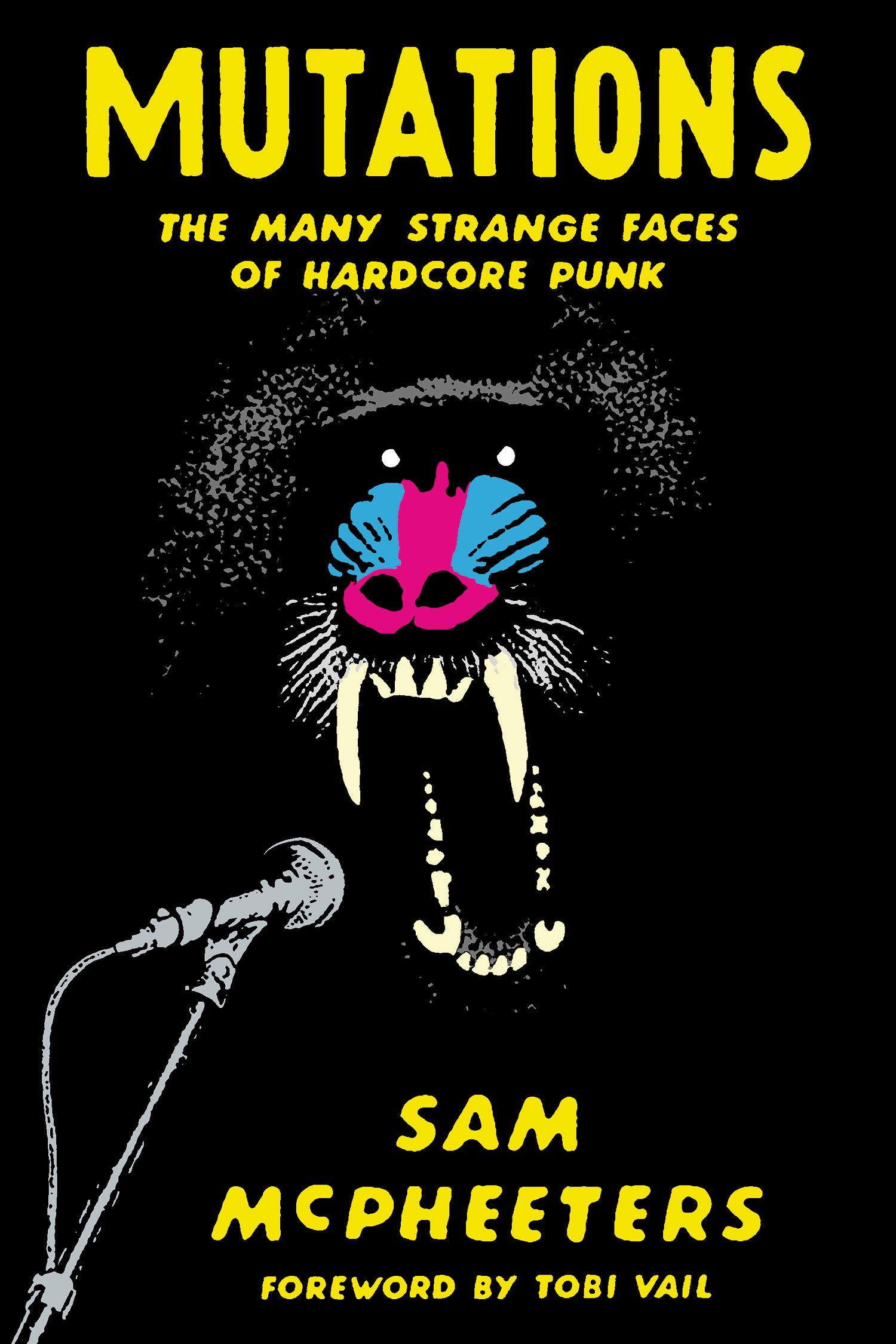
Mutations: The Many Strange Faces of Hardcore Punk  Sam McPheeters 

Years ago when I lived in Philadelphia in the first of many punk houses, I spent every morning before class sitting in the freezing kitchen, drinking black coffee from the percolator, and reading my way through Mike Azzerad’s Our Band Could be Your Life. As I leafed through the chapters about bands I loved—Minutemen, Black Flag, Hüsker Dü, Fugazi—I would forget how cold I was, transported by the possibility of other lives. Even the chapters on bands I wasn’t that interested in, like Butthole Surfers and Big Black, were diverting and funny enough to hold my interest. I immediately understood why the book was such a classic, because it accomplished exactly what it promised to do: produce the feverish haze that makes you want to drop everything and start a band. 

 Although I’d loved punk since 13 or so, this was my first experience reading musical criticism and oral history that focused on what punk meant, on the political, artistic, and cultural movements that created my favorite bands. The music stands on its own, but once you learn about the Minutemen’s philosophy behind making art, you arrive at a whole new understanding of the band. Moreover, by juxtaposing all the stories together, Azzerad clearly shows us the overlaps between the different scenes. Our Band Could Be Your Life quickly became one of my all-time favorite books. 

I haven’t felt this strongly about another music book until I read Sam McPheeters’ Mutations. McPheeters is probably best known as the vocalist of Born Against and the owner of the record label Vermiform. He was also an MRR columnist, and MRR and Tim Yohannan are all over these pages. McPheeters does a great job of capturing the magic of volunteering for MRR and exploring the record collection, and also gives a thoughtful overview of some of the controversies and critiques of the magazine. In one poignant moment, he and Aaron Cometbus confess their separate plans to save print MRR (a little late, though maybe they’ll like the website). 

I don’t listen to Born Against much, but it’s not super necessary to be familiar with McPheeters’ musical work in order to enjoy this book. The book is less about his bands and more about the bands that inspired him. He sets out to take us through all the unique phases of the music world he’s experienced, from riot grrrl fights to playing a fake punk for a music video. Ostensibly, he’s most interested in what he calls “hardcore” and what Aaron Cometbus calls “underground music,” although terms get fuzzy as the book progresses. I would say it’s a book about punk, with most bands fitting more into the hardcore genre but some (like the Flying Lizards and the Gossip) not fitting anywhere at all. 

The chapters are short and sweet snapshots into different genres and time periods. McPheeters manages to approach even the most misanthropic and belligerent subjects with compassion and genuine curiosity. His writing voice is a mix of Al Burian, Cometbus, and Steve Albini—self-deprecating and sarcastic but always with an underlying interest in other people. There is significantly more diversity (in terms of gender, race, and sexuality) in Mutations than in Our Band Could be Your Life, and McPheeters goes out of his way to highlight things like the homoeroticism of the hardcore scene, the strangeness of athletic straight men taking their clothes off and basking together in their youthful, sweaty glow. 

Early on, McPheeters establishes a mascot of his preferred type of hardcore through what he calls “Parachute Meat Person.” Parachute Meat Person is the caption on a grotesque photo of sausage stuffed into a parachute that he saw as a child in a newspaper photo spread on punk. Parachute Meat Person embodies what he believes hardcore punk music will sound like as a child: “the quick glimpses of chaos reminded me of all the violently abstract nightmares from the dawn of my consciousness. I assumed actual punk records would do the same.” He’s understandably disappointed then, when he listens to a Sex Pistols album and finds that it’s mostly just ordinary rock’n’roll. But this sparks a quest to find the real music that will capture his deepest horrors. He is looking for soundtracks to the apocalypse, songs that will transport him straight into the heart of an inferno. He finds it in bands like Die Kreuzen, the Crucifucks (or as they were known on fliers, The Christmas Folks), Discharge, and my all-time favorite, No Trend. He examines all of these bands in depth to figure out why they resonate, and along the way he meets like-minded people also searching for their own Parachute Meat Person.

Mutations is very personal, and McPheeters isn’t afraid to make fun of himself or discuss his mistakes. He describes at one point how he received an unexpected trust fund and in a short span of time, after funding the record label and paying his friends’ rent, lost it all. This kind of admission is rare to non-existent in hardcore memoirs, and the lack of posturing is refreshing. There’s also a great chapter on punksploitation and the famous LA punk club The Smell, a sort of rock-bottom for McPheeters where he agrees to play an 80s punk extra for a music video. He writes, “At some point I slipped into a Frankenstein dance… I think I was on the verge of a stroke at that point, I’m not sure. I do know that I wasn’t very happy with the way my life was going at that moment.” The layers  at work here are fascinating: the actual punk club with fake graffiti and hired fake punks plus one real punk trying to imitate a real punk club. 

But Mutations isn’t without some misfires. There’s a particularly bizarre chapter entitled “Please Don’t Stop the Muzak,” in which McPheeters denounces radio pop in favor of muzak, and verges on becoming the finger-wagging old man telling kids to get off his lawn. In order to make his point he revives tired rhetoric about “entitled Millennials,” stopping just short of the avocado toast: 

Millennials…you lead custom-tailored lives, from your social media feeds to the fancy drinks you expect your barista to get right day after day. You’ve grown up with the accumulated knowledge of humanity literally at your fingertips. You’re the first generation since the dawn of the Industrial Revolution without actionable levels of lead in your bloodstream. You should be far smarter than all of us who came before. 

He also spouts some questionable opinions, such as when he refers to the Misfits as more of a clothing brand than a band (all I’m saying is “We are 138″ has the same chord progression as “Teenage Kicks” and was recorded a few months before, he doesn’t at least find that interesting?).

But these are just minor quibbles with an otherwise wonderful book.  Mutations is an essential addition to the hardcore punk canon that raises important questions about what it means to define yourself in a community that is equal parts abrasive and loving. Our band could be your life, sure. 

But our Parachute Meat Person could be your nightmare. 

P.S. In case you do become horrified reading about the violent exploits of various bands, it might be helpful to know the cover glows in the dark. 

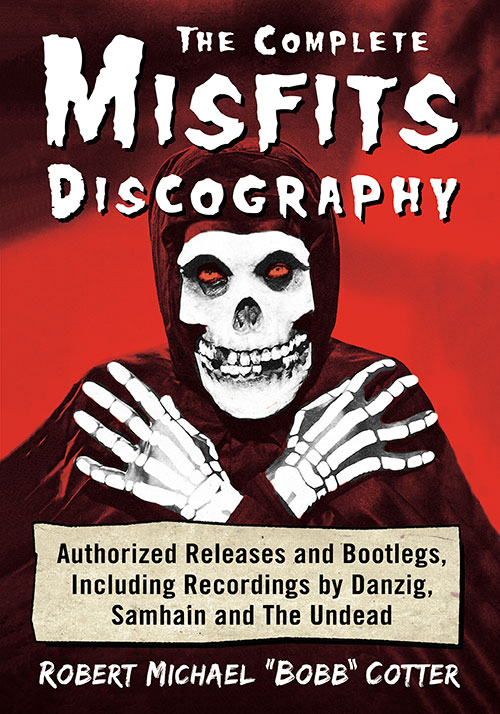
The Complete Misfits Discography Robert Michael "Bobb" Cotter

Alright folks, what we have here is an exhaustive discography for Lodi, NJ’s The Misfits with everything from its classic 1977—1983 lineup with Glenn Danzig, their sole songwriter, the sans-Danzig reunion lineups from 1995—2016, and up to some bootlegs from the current (2016-present) re-Danzigged lineup.

It has chapters on official releases, bootlegs, side project discographies, videos, merchandise, compilations, zines, tributes, etc.  Clearly the effort was to be comprehensive and on that level it succeeds.  Everything a big Misfits nerd (like myself) might expect to find is in here.  Each entry comes with a review.

The author is unquestionably a massive Misfits fan and it’s clear this was a labor of love.  The author’s voice is very loud and each review is highly opinionated: it plays like you’re over at his house and he is showing you his collection and telling you all the cool things about each piece.  

There are overviews of The Misfits and related bands for non-fans, but this book is for the die-hards who need every drop of info they can get, due to the amount of detail only true fans would care about.  This makes all the explanations a bit redundant; we all know the basics and a lot of the nerdy stuff.  As cool as it is to have the author’s opinions on these releases, interviews with band members, sleeve artists, studio people or any other folks who worked on the records could have given more of a new perspective.  Also the author has a lot of controversial opinions.  He’s a New Misfits (i.e. sans Danzig) fan, finds the first Misfits 7″ “artsy-fartsy crap”, the Bullet 7″ “not quite there”, and says perennial Danzig favorite “Sistinas” “couldn’t be any wimpier if it was bamboozling burgers out of Popeye.”  Hey, I love controversial opinions but unlike a conversation we can’t respond, so it’s closer to the author talking at you than connecting and can be hard to read if you strongly disagree.

Also of the 242 pages, just 16 are dedicated to the original band’s official discography (27 total counting later lineups) while 83 are dedicated to Misfits bootlegs.  I would have loved a stronger focus on the classic official records; they get larger individual write-ups than the bootlegs, but they’re the bulk of my interest.  It seems like if this were just a guide to bootlegs/related bands those chapters would feel more crucial.  

The author clearly had fun writing this and throws plenty of puns and silliness into the mix.  Sometimes it lands (reviewing the song “Where Do They Go?” — “I don’t know, but could this song go to the same place?”) and sometimes less so (“From the unreleased Samhain IV comes “Lords Of The Left Hand” which I guess is about Satan masturbatin'”).  

Overall I wouldn’t say it comes ripping or it bites.  You may wish that more than 1 out of 15 eyes (or 16/242 pages as it were) was pointed at the most important hybrid moments of the static age but if you wanna walk among the horror business with an expert and like his attitude, this just might take you where eagles dare and you should grab it for your next ghoul’s night in. 

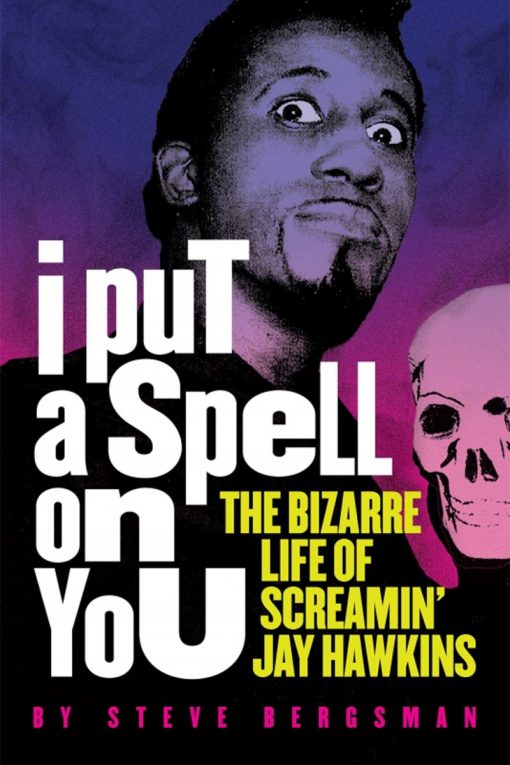
I Put a Spell on You: The Bizarre Life of Screamin’ Jay Hawkins Steve Bergsman


    The subtitle of this book, “The Bizarre Life of Screamin’ Jay Hawkins,” is a misnomer. His story, unfortunate as it might be, is similar to the less successful musical artists of his time, Black or white. He worked through the Chitlin Circuit. Used by artists during the first part of the 20th century, The Chitlin Circuit was a framework of Black-friendly venues spread out throughout the  American Midwest and South. 

    Hawkins had one hit, “I Put a Spell on You,” and couldn’t quite crack the charts again. He spent the 70s and 80s very poor as success evaded him. His importance grew as time passed and in his golden years he finally began to receive appreciation for his place in Rock n’ Roll history. 

    He had some 30 children with many different women. He had drinking and drug issues and a number of abusive marriages (just for clarification in all but one of those marriages he was the abuser.) Constantly broke because of bad business deals, he spent much of his time trying to get money out of others whether he deserved it or not.

    What makes Screamin’ Jay’s story different is he was such a teller of tall tales which range from the plausible to the titular bizarre. The author, Steve Bergsman, makes use of them by attempting to lay out as many of the different tales and trying to figure which one is the closest to the truth. But the book is still devoid of much depth. As an overview of Screamin’ Jay’s life and career, and the only book about him, it is serviceable but it reminded this writer of those books about notable individuals one could check out in elementary school just with cruder topics.  

    Bergsman makes no bones about the fact that Hawkins did time for statutory rape or the abusive nature of many of his relationships with men and women or the way he would address business matters with threats or a gun. Not that this is uncommon for the time period in any way. In a sense it makes the point that Screamin’ Jay Hawkins was a man of his time not unlike Wilson Pickett or James Brown. Bergsman does not not avoid pointing out the questionable nature of some of Screamin’ Jay’s stage antics, which were called out at the time by the NAACP for being a major step back for Black performers. 

    But that is where he leaves it. As a white writer, that is where he should leave it because I would be uninterested in his interpretation although, some nuanced view would have been nice. Maybe a couple of interviews with people with knowledge of the subject might have made this fluffy little book a little more enlightening, since Screamin’ Jay’s act took on a life of its own and is almost as well known as the song”I Put a Spell on You.” 

    Late in the book Hawkins’ relationship with the filmmaker Jim Jarmusch is brought up and, as a fan of Jarmusch, I noticed a few inaccuracies. For one, he describes Jarmusch’s Stranger than Paradise as a film about, “a rootless Hungarian emigre and his pal visiting his 16 year old cousin.” This is not true.     The Internet Movie Database says the movie is about, “A New Yorker’s life thrown into a tailspin when his younger cousin visits him.” Maybe this seems like splitting hairs but information that is the inverse of reality in a book where the writer goes to such lengths to describe the tall tales Screamin’ Jay told casts doubt on how well the previous 207 pages have been researched.

    According to the “About the Author” section at the end of the book, Steve Bergsman is a freelance writer and has written a number of books about Real Estate with titles like Maverick Real Estate Investing: The Art of Buying and Selling Properties like Trump, Zell, Simon and the World’s Greatest Land Owners. He’s also written books about Mary Wells, Billy Preston among other R&B subjects. I won’t be reading any of them unless they are more informative or, at least, written better than I Put a Spell on You.

All I Ever Wanted: A Rock N Roll Memoir Kathy Valentine

Disclaimer: this is a book for fans of the Go Go’s/rock ‘n’ roll/memoirs etc. It has precious little to do with punk. The writer of this review likes the Go Go’s more than the Gun Club so with all that in mind, read at your own risk.  

With no “real job” to go to during the COVID-19 pandemic and plenty of time to read  I bought myself copies of Substance, Peter Hook’s book about New Order, and Dream Baby Dream, a biography about Suicide. After those I digitally checked out Legs McNeil and Gillian McCain’s oral history on the birth of New York punk, Please Kill Me from the local library. After all of that I was pretty tired of reading about junkies and rock stars. 

I requested Kathy Valentine’s book long before I read any of these and when it showed up in my mailbox (thanks Caitlin) I was a little underwhelmed. I had chosen it but I was so burned out by stories of rock n’ roll and groupies and drugs that I hardly wanted to look at the book open much less read it. 

The Go Go’s have largely been relegated to the same ghetto as many other bands composed of women, disregarded as musically bereft or ignored all together. However, The Go Go’s primary songwriters Charlotte Caffey and Jane Weidlin (as well as Kathy Valentine) are solid pop writers.  In We Got the Neutron Bomb Henry Rollins astutely called the band, “a sturdy pop unit.” Kathy Valentine and Gina Shock are powerful as a rhythm section. Caffey is a wonderful lead guitarist who makes interesting choices pulling from a similar bag of tricks as X’s Billy Zoom, surf, early rock n roll, etc.

After reading in Peter Hook’s book about groupies who wore little trays on their heads so Gene Loves Jezebel and their roadies had somewhere to put their drinks while they got blowjobs, reading Kathy Valentine’s memoir was a breath of fresh air. Recently, celebrities writing their life stories has become something of a trend. Some are very interesting and some are bore fests. 

Kathy Valentine’s book certainly appears to be coming from some place of trying to reckon with her life, regarding her drug use and the narcotic fueled relationship with her mother and while she may be a wonderful songwriter (i.e. Vacation, Head over Heels) her memoir writing is  serviceable at best, which takes nothing away from the stories told.

One of the most wonderful things in All I Ever Wanted speaks to that title. This is truly a book about one person. The book doesn’t focus on the Go Go’s prior to her joining the band, gossip is kept to a minimum as well. Many times names are changed or not mentioned at all which, again, is in direct contrast to other celebrity memoirs where the reader is harangued with “tell-all” details and a laundry list of the writer’s sexual liaisons. This book doesn’t stray from some of this, and it certainly speaks to the excesses of so called sex, drugs, and rock n roll, but Valentine attempts to make amends for certain things and really only places blame on herself (or others when it’s called for.) 

One of the most poignant sections of the book, and something you couldn’t find in a book by Peter Hook, is when Kathy, finding herself pregnant and in a band with a record blistering up the charts decides to have an abortion and still plays that night at Madison Square Garden. It brings to mind a modern version of the Ginger Rogers quote about having to do the same moves as Fred Astaire but “backwards and in heels.”

The book is well worth reading if you’re a fan. Even if you’re not but you appreciate stories of underdogs or those struggling with substance abuse, there is plenty to chew on. 

Side note: The Plugz get more love in this book than in Marc Spitz and Brenden Mullen’s We Got the Neutron Bomb, the oral history of LA punk. Valentine points to the Plugz as been very important to the Go Go’s which on re-listening to their records there are definitely some stylistic similarities between the Plugz’ Better Luck and the Go Go’s first two albums. 

Soundbreaking: Stories from the Cutting Edge of Recorded Music Edited by Sandra Choron

When the mode of the music changes, the walls of the city shake.*

—Plato, The Republic

(as paraphrased by Tuli Kupferberg, THE FUGS)

    Soundbreaking: Stories from the Cutting-Edge of Recorded Music is the PBS documentary project comprised of over 160 original interviews with artists arranged into eight theme-oriented segments. The slick oversized hardcover book MRR was given to review features biographies “in their own words” of twenty-one artists, performers, producers and engineers, while the TV episodes are organized around developments in recording technology and techniques instead of musical sound, genre or history. BEATLES producer George Martin’s final project, Soundbreaking was not a labor of love, inclusion, erudition or illumination so much as a promotion of artistic individualism and techne. A celebration of artists and their techniques. 

    The project embodies the 19th century “great man theory” transposed from history to music. From this perspective, unique individuals with natural attributes—superior talents, heroic endurance or transcendent inspiration—come to be highly influential and have a decisive effect on music. Like “great men,” great artists are not made but are born or can be summoned forth by some unique moment in time according to the theory. Instead, they are ultimately the products of their environment. Or as playwright Bertolt Brecht rhetorically asked about the “great men” depicted in his poem “A Worker Reads History”: “He alone?”

    So Soundbreaking doesn’t deal with how rock and roll as a musical genre came to be or changed the world, but rather how Les Paul’s novel invention of the solid body electric guitar or Eric Clapton’s “brilliant” use of that guitar changed that genre. This perspective ignores that “great artists” are rife with flaws, contradictions or outright villainy and whitewashes the unsavory aspects of their character. We’re encouraged to disregard that John Lennon was a wife beater, Eric Clapton a racist, Phil Spector a murderous psychopath, Beck a Scientologist toady or Paul McCartney a banal turd because they are “musical geniuses.” Soundbreaking mentions that Elvis Presley and LED ZEPPELIN stole from Black musicians only in passing, thus sidestepping a broader discussion of the historical importance of Black music to rock and roll. In intentionally avoiding any overarching historical or sociological framework—context if you will—what results is a scattershot “hit or miss” approach. All of which means that Soundbreaking is often temporally jumbled, topically muddled and ultimately lacking either an individual or historic pivot.

    Before going further, there’s much to be admired about Soundbreaking. Many of its interviews and themes are brilliant, provocative and informative. Its aesthetics are gorgeous, from the archival black and white film footage to the studio quality sound and the elegant coffee table book. The series is full of amusing, stunning, even revelatory moments. For all its shortcomings and boring interludes, the series is riveting and the book collectible. Some artists (Tupac Shakur, Kanye West) and types of music (underground, independent) are barely mentioned. No matter what approach is taken or how comprehensive the intent, aspects are invariably left out (Patti Smith, punk rock). The complaint that Soundbreaking fails to see the forest for the trees still means there are plenty of wonderful trees to enjoy.

    Given the sheer volume of information the book and series have to offer, a few examples will suffice. In the category of “genius artists,” numerous musicians marvel at Phil Spector’s “wall of sound” technique, yet nothing is mentioned of how demanding, abusive and egomaniacal the legendary record producer was let alone any broaching of the issues of mental illness or homicide. The interview snippets and chapter devoted to Joni Mitchell, while insightful, fall short. “I’m a painter first,” she says. ” So to me, a producer is completely unnecessary. […] When I began to record, most of the men were very resistant to taking instruction from a woman. And a producer is often a sycophant, a babysitter. If you know how you want to make your house, you don’t need an interior decorator. […] When I got my first record deal I requested that I would not have to work with a producer for personal reasons so that I could continue my experimentation and allow my work to unfold organically.” Her rapturous praise for self-production notwithstanding, Joni Mitchell reveals that sexism in the music industry is the real reason she didn’t want a producer, a subject that is never revisited.

    The episode “Sound and Vision,” about the rise of MTV, is a waste, an incomplete portrayal of the profit-driven cable TV channel that presents MTV as trite, derivative and not at all cutting edge. By contrast “The World Is Yours”—the episode devoted to rap, hip hop and sampling—is a true revelation. Denied access to musical instruments not to mention recording studios, record contracts and industry support, rap and hip hop artists used sampling to revolutionize music at the time. Called the “musical equivalent of Adam’s rib,” the art and practice of sampling didn’t just add sound samples to an artist’s song as yet another element of musicality or kind of instrumentation. The artists using the technique intended to make sampling into its own art form, a way to create new songs and original music, and was therefore also a profoundly political act. “Sampling is basically the ability to take a piece of a song and then loop it,” record producer Jimmy Jam says. “You make it go over and over again and then create a new song.” 

    Culture commentator Jason King makes the connection to politics explicit when he asserts: “There’s a kind of political aspect to the sampling of PUBLIC ENEMY. They were sampling particular artists, particular sounds that referenced the entire history of Black musical materials. They connected the past to the present to the future.” But the music industry, including many musicians, equated sampling with stealing other people’s music despite the fact that “[t]here’s really a limited number of notes and a limited number of chords, and these have all been replayed throughout history” according to record producer Mike Simpson. Unlike individual cases claiming legal harm (SPIRIT v. LED ZEPPELIN, Sean Hall et al v. Taylor Swift), the whole corporate music industry sued rap and hip hop artists for copyright infringement and used both legislation and tracking technology to crush the art and practice of sampling. So, unless you’re a multi-millionaire rapper like Kanye West who can afford to pay exorbitant fees for sampled beats, sampling is illegal.

    Soundbreaking’s TV episodes start in the present, jump backward and forward, repeating until timelines are often hopelessly jumbled. Various themes become muddled with too much attention to detail and fascination with minutia, racing to connect all the dots in an episode until the viewer loses sight of the bigger picture. Clear narrative structure frequently suffers. The series hits many high notes, to be sure. But they can’t be sustained because of uneven tone, style and method.

    I grew up believing rock and roll was a revolutionary form of music, only to experience my favorite rock songs become soundtracks for car commercials. At the risk of getting mired in an intractable “form vs content” debate, I’d contend that both form and content can be revolutionary but both are easily co-opted. The deliberate dodging of historical and political context in particular means that all these wonderful artists—no matter how “great” or “brilliant” they might be—amount to a loose gaggle of unassociated talent. No one stands out above any other, leaving George Martin—”the fifth BEATLE” who knew and worked with most of these artists—the default pivot of Soundbreaking: Stories from the Cutting-Edge of Recorded Music. Thus life imitates art.


*When modes of music change, the fundamental laws of the State always change with them. —Plato, The Republic (original quote)

Teaching Resistance: Radicals, Revolutionaries, and Cultural Subversives in the Classroom Edited by John Mink

Writing this review is so surreal. I began reading this book in my 8th grade classroom and am finishing up the review sitting at home after being quarantined indefinitely. The world is at a standstill, and people are fighting for their lives in the first global pandemic in a century. For teachers, traditional pedagogy has been replaced by Zoom meetings, concerned parents, and a constant worry that students have access to basic necessities like food and a safe place to live. The world changed on us very quickly, but teachers (most of the ones I know, at least) are still doing what they can to provide equitable resources to students with compassion and patience. Teaching Resistance is a guide for those of us who are trying our best to create a safe, nurturing space where our students’ needs are met in the least restrictive, most progressive ways. If you are into punk, radical politics, activism, or are looking for a practical, relevant education book that is student-centered and real, skip this review and just go buy it. Better yet, get your school to buy it for you.

Teaching Resistance, edited by Fleshies vocalist and teacher John Mink, collects and expands on entries from MRR’s column of the same name. It includes essays from educators, writers, and students all across the world (particularly interesting are the insights given into politically/culturally repressive areas like Palestine, Serbia, Bible Belt America, and even prison). It also has engaging interviews with radical teachers, including punk lifers like Alice Bag and Martin Sorrondeguy (Los Crudos, Limp Wrist).

Although the perspectives are varied, the common threads that bind many of the pieces together are much like punk itself at its best: classrooms need to be anti-racist, anti-authoritarian, culturally relevant safe spaces where students and teachers feel comfortable to exchange ideas and work together to grow and learn. In these reflective essays, educators write about how their time spent in DIY punk enabled them to reach kids of all backgrounds. The techniques range from simple listening and caring to fighting forces that would threaten their safety. In his essay “Cops Out of Our Schools,” Mink expresses this by saying, “It has been shown, time and time again that teachers who are genuinely dedicated to the core (non-institutional) philosophies of their profession can, through radically innovative practices and active subversion of the institutional aspects of their jobs, play a major role in helping empower their students to take greater control over their own lives and potentially become catalysts for effective real structural-social change.” I can’t think of a better mission statement for modern teachers.

These accounts show the dedication many radical teachers have for their students and the sacred space of a peaceful, open learning environment. The chapter by dwayne dixon (the lowercase letters are intentional), a professor at the University of North Carolina, details how he confronted armed far-right agitators who were marching to protect a campus Confederate soldier statue right outside his classroom window. (Side note: a happy surprise for me was when one of my 8th grade students described her summer experience pulling down this controversial symbol of white supremacy). Similarly, there is a powerful essay describing how leftist and Antifa groups combatted Neo-Nazi riots right across from Berkeley High School. I don’t have to elaborate on how concerning the growing trends of conservatism, fascism, and anti-intellectualism are, but the reports from the front lines, as it were, show powerful people standing up and demonstrating what activism can accomplish.

Among the issues addressed in this collection that are of particular interest to me are ways of working with students who often “fall between the cracks” in the traditional public school structure. I am fortunate enough to work in a public creative arts magnet school that has a very diverse population, both racially and economically, and has a relatively large number of LGBTQIA+ students. I sympathize with students and teachers who have to spend time in places that are not accepting or equipped to best meet their needs. Chapters on reaching out to kids who have experienced trauma, working with the children of immigrants (Sorrendeguy’s lengthy interview was particularly insightful here, as was Bag’s, where she advocated for students learning in their first language), students who have physical and learning disabilities, and those who are not neuro-typical are so relevant and rare in standard educational texts, and I appreciate their inclusion and perspectives very much.

This is an excellent collection that I can’t recommend enough if you teach in any capacity. It is compassionate, thoughtful, and authentic. You never know who will walk through your classroom door, but it is your duty and privilege to connect to them and share ideas. In his interview, Sorrendeguy says, “I think that is how I think of education in general. It can really make that impact on somebody. My friends in Southern California used to talk about huellas; leaving fingerprints. We leave fingerprints everywhere. It’s like when people talk about a ripple effect. You’re leaving a mark, and you may walk away and go on in life, and you don’t even realize the fucking impact you made

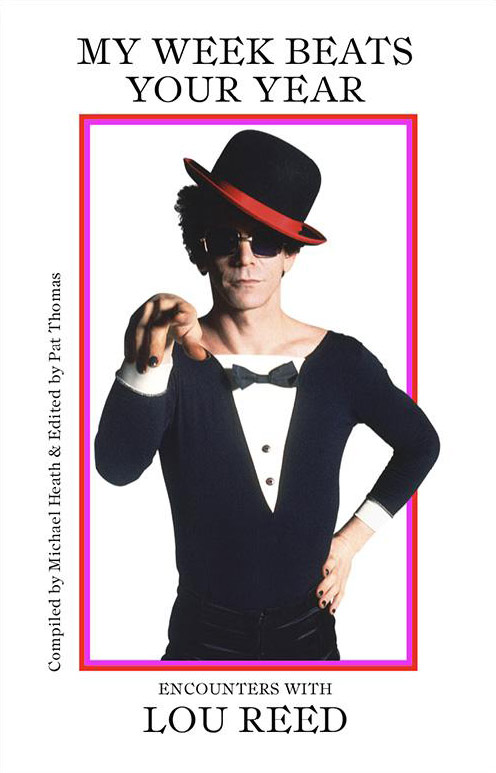
My Week Beats Your Year: Encounters with Lou Reed, 1972-2013 Compiled by Michael Heath

For a wallflower like myself some records and bands are like good friends. I don’t have many real people in my life, a few very close friends and family but not a large group of buds or acquaintances.

So on some lonely night when maybe I don’t want or can’t reach out to someone, me and a good record can sit down and they’ll speak, I’ll listen and the record understands me better than anyone else could.

Then there’s Lou Reed (and the Velvet Underground). That’s not a friend on my record shelf, that’s family.

I can’t remember where I first heard the Velvet Underground but it was probably in a movie. I was hooked quickly, specifically on the first Velvet Underground record and Loaded and as time has gone on records that I didn’t understand when I was 16 like Street Hassle, the second self titled VU record or Metal Machine Music have become favorites.

It’s rare that a band or an artist can grow with you, or that you’d even want them to. I still have trouble with those later Bad Brains records. Some bands don’t even get that far and you can only wonder what would have been. Team Dresch will always be crystallized in two great albums and a few singles.

Lou though kept on keeping on. Some of those records I will grow into and others I can’t ever see understanding, like Lulu.

I don’t much care when celebrities die. I don’t know them. I have only this small piece of their lives which is their work. Like when Bowie died. David Bowie is great but for me, I don’t really know/care for his work after The Lodger. I’m sorry that a human being doesn’t exist any more but I don’t know that person.

When Lou died however, it stopped me in my tracks. I called my best friend, or they called me, I can’t remember now and we talked for a while, the Velvets mean a lot to both of us. I cried, which I’ve never done when a famous person had died.

But Lou is family, the cantankerous uncle. The cool guy you can never get close to.

This book of interviews which covers most of his career, there is precious little from the Velvet Underground days, and most of his interests.

There is an interview specifically about his photography and another from a Kung-Fu magazine where he talks about his interest in Tai-Chi. To paraphrase Lou, it covers his drug phase, the no-drug phase, the Prozac phase, the no Prozac phase, etc.

It’s interesting to see how the many of the writers here relate to Lou’s music. It becomes easy to see why he is so frustrated with them. They don’t appear to be fans past 1972’s Transformer. To be in your twilight years after almost 60 years of writing and recording material and be asked about songs from your first couple of records must be grating.

They also lean heavily on the songs of substance abuse and “deviant sex” as if that’s all he wrote about. Not even “Venus in Furs” is only about S/M. Even in the darkest depths of Lou Reed’s words there is a tenderness and depth that most other writers could only dream of.

As the afterword by Pat Thomas points out, “There is no reason for me to tell you why Lou Reed is great. Hopefully you know that and if you don’t, well, I can’t help you now.”

Lou comes off in this book as a three-dimensional person. Which is amazing since interviews generally paint an artist as the embodiment of whatever work they are promoting at the time and thus lose the color of an individual.

In some of these interviews Lou Reed is shitty to the interviewer but in some cases he appears provoked, in others not so much. The Australian interviews from the 70’s which can also be found on Youtube are particularly entertaining for the way Lou plays with the press.

Any of these interviews taken by themselves might have that quality but seen zoomed out, as a collection, you see a person. A very gifted person, who was a proselytizer of the power of music, a nerd about electronics, a diligent song writer and a patron of the arts.

It’s pointed out in the foreword by Luc Sante that there are some interesting through lines in the book: his mercurial relationship with John Cale and his continued, almost blind, adoration of Andy Warhol, to name two.

For me, I have always been a little troubled about Warhol but Lou knew him and has much more reason to appreciate him. He mentions often in these interviews that it was Warhol who, during the recording of the first Velvet Underground record, told him not to bend to anyone’s will, to not change anything for anyone.

It’s easy for a person like myself to look up at Warhol from the street and think about what he did to Valerie Solanas (and what she did to him) along with others in borrowing (read: stealing) ideas and credit as well as his lack of, well, making work in the manner that I think of as making “art” with a capital A.

But Lou is smarter than me and he saw Andy’s hard work, whatever that meant to him.

I don’t read this as an admirer of every single record Lou Reed made, in fact some things he has done are down right garbage in my opinion, but what I get from these interviews is that it’s all right to feel that way. Lou seems to feel that way but if you’re not ever trying, pushing, forging ahead with ideas and technique how can you ever get anywhere? Sure, there will be missteps but if great work comes out of it, then the whole ends up being much more than the sum of its parts. In Lou Reed’s case, it certainly was.

P.S. — The book’s layout and printing are absolutely wonderful. There is such care put into this book that one wonders why all books don’t have such a patina.


Revenge of the She-Punks: A Feminist Music History from Poly Styrene to Pussy Riot Vivien Goldman

If any MRR readers out there are still questioning the need for a book of feminist punk history in 2020, allow me offer the following example: consider a certain popular book on the history of Spanish punk that includes a section listing important countercultural figures and musicians in Spain during the 1980s. Out of a total of 57 figures listed, 4 are women. I fear young people will pick up a book like that and assume that women weren’t a part of early punk scenes, and, by extension, that they aren’t a part of punk today. The forcible erasure of women from punk’s history is a well-documented problem, part of what Vivien Goldman hopes to fix with her new book, Revenge of the She-Punks.

Goldman, often referred to as “The Punk Professor,” is an ideal person to take us on a tour of feminist punk history. She’s interviewed many of the punk’s most famous women and was a musician herself, both solo and with post-punk outfits Chantage and The Flying Lizards. Her song “Launderette” is a perfect slice of dub-tinged punk that encapsulates London bohemian life in the early 1980s. In Revenge of the She-Punks, she sets out to tell the backstories that inspired Launderette and songs like it, travelling around the world to prove that women have always been an integral part of punk scenes.

Goldman wisely defines “punk” more as an ethos and a DIY, rebellious attitude rather than an aesthetic perspective or specific sound. She includes artists that fall under genres such as electronica, ska, and hip-hop, allowing us to see the ways that punk and feminism are (re)interpreted in different cultural contexts. Likewise, she defines “women,” broadly, including non-binary people and allowing for nuanced discussions of bands like Tribe 8, a pioneering queercore group that counts several trans men amongst its members, while still firmly identifying as a feminist band. Revenge does not try to be a definitive history of women in punk (though, if that is your thing, many of your favorites—Alice Bag, Poly Styrene, Vi Subversa, Bush Tetras— will likely be in here). Rather, Goldman sets out to explore universal threads between bands over time. Looking at punk through a historical lens also allows us to understand generational links between bands, and see the ways women mentor each other over the years.

Unsurprisingly, we quickly find that many of the issues women were upset about in the 1970s (rape, economic inequality, racism), are still frustratingly relevant. Although women around the world deal with different levels of political repression, they all experience violence and pushback from men and the music industry. The danger of a global feminist history is that it can tend towards essentialism (the belief that all women are the same) or setting up a problematic West = good/East= bad dichotomy. Goldman for the most part avoids this, taking pains to show us surprising viewpoints, such as Gia Wang: outspoken feminist, singer of Chinese pop-punk group Hang on the Box, and also a huge Trump supporter. Clearly, gender, and even involvement in a women’s music group, does not guarantee a specific political outlook.

Goldman also uses her journalist’s eye to highlight many interesting, lesser-known facts throughout the book (The Mo-dettes were asked to be on Eurovision! Bush Tetras loaned ESG their first amps!). One of the most interesting sections is when Goldman recounts an interview with icon Grace Jones in 1982. When Goldman asked what it was like having Jean-Paul Goude, her (white, French) boyfriend at the time, also serving as her photographer, Jones broke down in an elevator and started sobbing, “He always wants me to be an animal!” Goude is responsible for producing many of the most famous images of Jones, and her implication that he dehumanized her provides an important critique of a man who published a book entitled Jungle Fever, featuring a naked Jones in a cage as the cover. We need more stories like these, that get at the complicated intersections of image, art, race, and gender.

Easy to read, engaging, and fast-paced, Revenge of the She-Punks would make a great gift for your niece headed off to Girls Rock camp, or your nephew who listens exclusively to Green Day. Personal stories, rare interviews, and quotes, what more do you want— a curated mix? OK, Goldman also includes a playlist in each chapter to go along with the theme.

Revenge is a timely and necessary text, an important celebration of everything punk women have been able to achieve under adverse conditions. As Goldman reminds us,  “Making things happen wherever you are, cleverly circumventing obstacles based on your class, gender, race… that is… punk’s heartbeat.”

Firebird Mark Powell

For a moment, I thought I’d wandered into the pages of a young adult novel. Then again, there’s more sex and drugs, murder and mayhem in The Hunger Games then there is in Mark Powell’s turgid fiction Firebird. This is a sadly bloodless, oblique effort fashioned as a behind-the-scenes story of recent historical events.

Powell’s tale is set in the Ukraine crisis from roughly mid-2013 to mid-2014; from just prior to the Euromaidan protests to soon after the Russian military intervention that annexed Crimea and instigated pro-Russian secessionist rebellions in eastern Ukraine. An omnipresent American corporation called Leviathan Global is fomenting instability and war in Eastern Europe by engaging in clandestine arms smuggling in hopes of switching out Europe’s reliance on Russian oil and gas for newly discovered deposits of Slovakian shale gas. Plotters seeking to take down Leviathan and its principles fall out among themselves, and a couple of the arms smugglers have gone rogue. A secret electronic dossier called FIREBIRD “that outlines all of Leviathan’s holdings […] Alfa Bank, Paradise Financial, the URLs originating in the Caymans […] Leviathan’s 19% stake in the Russian oil giant Rosneft” is rumored to exist which, if revealed, will destroy the company. And yet, despite all Powell’s tropes of international corporate intrigue, he fails to deliver an action suspense thriller.

Powell’s writing itself is clean and precise and on occasion evocative. He manages to respectably handle a dozen characters within 300 pages. The problem here is that the cast of characters is forgettable. Among them is a poisoned dissident Czech colonel and his daughter out for vengeance, a Leviathan CEO and Slovakian ambassador whose wife sees auras and is in love with her spying maid, a billionaire Hispanic Leviathan co-founder contemplating a presidential run, a reprehensible political fixer with JUIF ERRANT tattooed to his arm, and a Cuban-American congressman set up for embezzlement—all so cozily interrelated as to constitute a soap opera set to evangelical neo-conservative GOP politics. An Iraqi veteran/independent contractor with a conscience named Hugh Eckhart and the lover of a murdered would-be monastic who is unsure of her Christianity but dead sure about exacting revenge named Sara KovÁ¡cs are the book’s two protagonists. They are foils seemingly intended to illustrate some obscure religious debate between Dietrich Bonhoeffer’s Letter & Papers from Prison and Arthur McGill’s Death & Life. Hugh’s last name suggests the famous German mystic Meister Eckhart and Sara’s surname AndrÁ¡s KovÁ¡cs, founder of the neopagan Hungarian TÁ¡ltos Church.

Firebird is laced throughout with such religious references, interminable theological ramblings, and occasionally interesting descriptions of mystical experiences. The WojtyÅ‚a Society for Peace and International Cooperation is a Polish Catholic humanitarian NGO and Leviathan’s secret direct action smuggling wing. The covert all-male Covenant is described as “a secret club, maybe, an evangelical Skull & Bones” made up of the politically connected and influential. Characters experience spiritual epiphanies and the “fear and trembling” of encountering an obviously Protestant god. After one such kairos, Sara transforms into a mysterious figure crossing borders “back and forth, always silent,” smuggling refugees. And Hugh is haunted by the vision of an Angel after his tour of duty in Iraq, “a great radiant thing standing over the dead children, their wraithlike bodies on the cool concrete, the long spills of their mud-colored hair.” All this god talk is neither irksome nor enlightening. Just very, very mainstream Christian.

There are tantalizing glimpses of Ukraine—a back lot arms deal gone deadly wrong, Occupy riots in Kiev’s Maidan Square—but this fiction is set almost entirely in the nondescript universals of conference rooms, campaign fundraisers, hotel rooms, meetings in private restaurants, office rooms, cocktail parties, etc. The clandestine Russian “little green men” invasion of Ukraine, when it comes late in the book, is experienced only through TV coverage. This is literary bait-and-switch, or perhaps everything just falls short of what seems promised. Take FIREBIRD, that potentially explosive electronic dossier. It’s stolen by Hugh out of guilt in an attempt to bring down Leviathan who then attempts to pass it on to Sara who is promptly kidnapped by various plotters. FIREBIRD finally falls into the hands of the Cuban-American congressman who misjudges how to exploit it and is forced to “commit suicide.” The electronic dossier quietly evaporates two-thirds of the way through and by the end of Firebird: “Leviathan was pumping gas out of Slovakia. The billionaire had been elected president, and though besieged by investigations, had announced his intention to seek a second term.”

Can you say anti-climactic?

Aside from a mention of Stravinsky’s opera, Powell fails to capitalize on his book’s namesake and default McGuffin. There are no allusions to the fabled firebird of Slavic mythology for instance, certainly a missed opportunity. And despite some last minute action Firebird peters out by the end, feeling partial and incomplete. Mark Powell has been lauded as “the best Appalachian novelist of his generation,” but this literary foray into international intrigue falls flat and ultimately disappoints.

Sunshine on an Open Tomb Tim Kinsella

Tim Kinsella, indie/emo/punk experimentalist behind bands like Cap’n Jazz, Joan of Arc, and Good Fuck, has gained a loyal following and irritated critics in the punk world for decades. Innovator to some, pretentious art-troll to others, Kinsella’s work usually elicits strong responses either way. In his new novel, Sunshine on an Open Tomb, Kinsella applies the same left-field energy, and dare I say, pretension in a work that will probably not gain him new fans but is rewarding to the committed.

The novel follows the unnamed son/black sheep of a very prominent American political family (essentially the Bush dynasty with names slightly changed) as his father prepares to run for president in a divisive 1980s United States. Our protagonist is kept out of the spotlight so as to prevent any embarrassment to the Family, members of an elite Blood Line (capitalizations Kinsella’s) that reaches back centuries. He retreats to live among the Barbarians, America’s non-elite, who are kept satiated with highly censored 24-hour news and are reminiscent of Orwell’s proles. He spends his days hanging with his buddies, eating at a particular diner every night, and pining after his regular waitress. 

This is where the story becomes much more interesting, and much more strange. To contradict a recent autobiography by his politically ascendant brother, Junior (a bumbling George W. Bush), our narrator  begins telling his side of the Family’s history that is so entangled with major 20th Century events that it almost comes across like a whistle-blowing confession of America’s super elite. The Family has had hands in many different pots, the most important one being Big Oil. They make important strategic friendships with the Saudi kingdom, get uncomfortably close to JFK’s assassination (referred to as “King Arthur’s very public skull-chipping”), have ties to wars in developing countries, etc., and it seems way more than coincidental. He builds such a case through a quick survey of backstage US leadership, secret society influence, and long-term hegemonic influence by a powerful few that Kinsella almost had me reaching for the tinfoil to make a new hat. It is compelling reading the connections relayed so casually, as if the tip top of the 1% is spilling the beans to spite his own insular world. 

The novel’s other conflict is within our protagonist’s own self, as he tries to obliterate his obligation to The Family and become as useless and secluded as possible. It reaches a point where he creates the titular tomb out of soup cans in a basement-bunker and plans to stay there forever. Coming to terms with the societal expectations and philosophical framework that comprise the Self isn’t easy, and our narrator seeks to destroy them and start fresh, just as his tell-all is finished. Whether or not you find a character of extreme privilege bemoaning the futile nature of life interesting is up to you, but there is some universality to his personal dilemmas. The desire to sever ties with overbearing families, to bite the hand that feeds (in one scene, literally) is not a new concept, and Kinsella claims that humans (“we dimly sentient blobs on this mysterious and watery poisoned orb”) share many existential crises regardless of birthright or social standing when he says, “everyone struggles with interiority.”

Defying standard, linear plot conventions (the novel occasionally drifts into fantasy sequences, daydreams, and Big Question ruminations), Kinsella also experiments with language that lands it somewhere between Joseph Heller’s repetitive verbal gymnastics in Catch-22 and Anthony Burgess’ pidgin language in A Clockwork Orange. Kinsella essentially eliminates all dialogue from our narrator in a way I have never seen before, negating the importance of spoken language in a story that has more to do with interior character struggles anyway. 

An example: 

“Duh, unga-bunga.” My pleading tone stunned me. I cleared my throat. “Duh, unga-bunga.” 

“This is my fault?” 

“Duh, unga-bunga.”

 She turned away from me again, shaking her head. “So, what are you doing?” 

“Duh, unga-bunga,” I said, aware that I sounded like a whiny little kid.

This runs for the entire novel. For a story as complex as this one, having the main character’s voice reduced to caveman-speak was a bold choice. It was also very off-putting at first until I became used to the rhythm of the story-telling. This kind of deconstructive whimsy took some patience and honestly tested my willingness to continue reading, so it might not be for everyone. However for those patient readers ready for a conspiracy-riddled tale of ego-death and organized crime in the White House, Sunshine on an Open Tomb is worth your time.

A City Made of Words Paul Park

If you’re like me, you might think that reading dystopian fiction is hardly necessary these days, what with the Incels, children in cages, and the rapid expansion of shanty town style tent communities in the most affluent cities in the country. But Paul Park’s excellent collection of stories A City Made of Words is a refreshingly trenchant take on the genre.

Part dystopia, part “literary metafiction” the stories in this collection straddle some interesting realms. Yes, some are about Mars and climate change, but others are a glimpse behind the curtain of the writer’s craft. In “A Conversation with the Author”, Park’s narrator—himself a graduate of an expensive Midwestern MFA program—interviews an author, who teaches writing to undergraduate students. He says, “(the author) was someone we’d picked up during one of our sweeps of the docks. He’d been apprehended lurking underneath the pier and then relocated to a camp for displaced persons. Now we’d brought him in for questioning.” The narrator interviews the writer— who is seated in a wheelchair with his arms strapped in plastic restraints—and proceeds to argue with him about the value of the traditional fiction writing workshop. It is a very weird story, shifting between critique of MFA programs and a depiction of some kind of totalitarian regime. The author has insightful things to say about the colonialist—even white supremacist—assumptions behind writing instruction, and offers a series of ideas for an entirely new course of study. It is never quite clear whether Park himself is the writer, the interrogator, or both. Or neither.

Other stories in the collection are equally original, well-written and humorous. Each is filled with cool ideas, perspicacious social commentary, and seems to explode the boundaries that constrain sci-fi and speculative fiction. A great, refreshing read.

My Butch Career Esther Newton

Modern academia has a well-deserved reputation for stuffiness, so imagine entering that world at a time when not wearing skirts—and, perhaps, being a woman at all—was considered unprofessional. Esther Newton is a queer anthropologist best known for her book Mother Camp, the publication of her doctoral research on drag culture. As implied by the memoir’s title, she identifies as a butch lesbian. She defines butch as a woman who’s sense of self is rooted in a kind of masculinity. Having navigated American culture as a gay woman before Stonewall, she says coming out was not a concept as it is today. One would first come to terms with their identity, then reveal to an underground community of queer folks. But there was never the openness and pride that we now celebrate. As Civil Rights Movement activists fought their battles, Newton kept her head down in the academic world. Her mother had been removed from her university for her activism, and Newton learned to stay quiet in the face of injustice. Her secret hinged on her ability to claim that she was interested in male gay culture as a detached anthropologist.

Reading the introduction of My Butch Career, I tensed as she opened with speculation that butch women would go extinct with the increased publicity of the trans movement. She didn’t seem to have a grasp on the language of the present day trans community and fretted that butch women would become men. Oh no, I thought, she’s a TERF. (A brief primer for those uninitiated into feminist in-fighting: TERF stands for trans exclusionary radical feminist. I’m not sure why this group awards itself the “radical” part of the term; there’s nothing radical about excluding trans folks from liberation.) She speculates that maybe she would have wanted to transition had she been aware of the trans community as a child. I ended up with the impression that she wasn’t unsympathetic, but lacked the modern language of the movement. 

I found much of the language around other social issues clunky. Newton is inescapably bourgeois: her greatest adult struggle was getting tenure. For anyone blissfully unmarred by the political world of academia, tenure is a shield from firing except in extreme cases. It comes with a lifelong pension. Granted, her initial denial of tenure was likely due in part to homophobia and misogyny. I’m sure it hurt. But the lack of class awareness was glaring. After securing tenure at another university, she spends years on paid leave in Paris, quintessential city of luxury in the minds of many Americans.

One of the pitfalls of memoir as a form is that the author inevitably finds their petty disputes more riveting than the reader will. She describes the tumult in her relationship with her college roommate turned lifelong best friend. When her best friend marries and becomes pregnant with a son, Esther disavows her, saying that she’s become a vessel for men. Weightier events aren’t given their due. In an off-handed comment in the final chapter, she refers to getting attacked by a homophobe at a skating rink and breaking her wrist in three places. This story occupies a fragment of a sentence and reads as a mere inconvenience amidst relationship troubles. But hey, it’s her memoir.

Dog obsession is a part of this memoir in an odd way. Her mother fixates on papillons, a breed I had to Google. Newton becomes a poodle person. Their shared obsession with dog breeding alludes to an interest in pedigree of dogs and humans. Newton spends a lot of time on the origin story of her family, going back to great-grandparents. She discusses her dual identity as a WASP and a Jewish woman. She’s either demonstrating that she comes from good stock, or trying to find her place in a world that’s marginalized her for her sexuality and expression. Is she an aloof academic who’s lost touch? Is she a pioneering researcher who forged the way for women and queer folks? Possibly both. Whether you enjoy this book may come down to your interpretation of its author’s intentions. 

About Anarchism Nicolas Walter

Nicolas Walter was born in England in 1934 to a family of dissenters. He wrote or edited for a number of radical rags in the early 60s until he retired in the early 00s. Although the following story is a digression I think it might best exemplify the author’s credentials as mentioned in his daughter’s preface.

In 1963 Walter, his wife Ruth, and other members of the peace movement had come to find that their protests and sit-ins were getting good press but having little effect on the English government. One of them remembered a “friend of a friend” who had worked in a “secret bunker near Reading”. They drove out and walked around for hours in snow and ice trying to find the bunker. Finally they came to a fenced off hut and climbed the fence. They thought it would be locked but tried the door anyway and to their surprise it was open. Once inside they found another unlocked door and a long staircase leading underground. They ran down the stairs and took whatever papers they could get their hands on before leaving with much haste one imagines. 

What they had discovered was “a secret government headquarters called the Regional Seat of Government Number 6,” and found plans their government was making, “for the survival not of the ordinary but of a political elite.”Walter and his friends called themselves the Spies for Peace and set off to the bunker a second time, this time with a plan. One of them took photos, another made copies of documents, and still another searched high and low for more information. 

They made some 3,000 leaflets with the material and carefully sent out packages, from different addresses and wearing gloves, to newspapers and other sympathizers. Afterward they burned the original material and threw the typewriter they had used in a river. The newspapers were instructed not to print any of the material but they ignored this and did it anyway. Days later it was in “every newspaper”.

As Natasha Walter points out this act did not accomplish very much in the long run outside of more protests yet, in a way it accomplished plenty by making sure people knew “about the secret military preparations of their government.” Which Natasha believes, “found fertile ground in changing society.”

About Anarchism was written in 1968. It was first published as a pamphlet. By 1977 it had gone through five printings. When it went out of print in the early 80s Freedom Press wanted to reprint it again but Walter said he had to revise it first. Those revisions, which would address feminism and environmentalism, were never finished by Walter. They were later incorporated into the 2002 edition and are also included here. 

This small book, about 50 pages, as Walter himself points out is not comprehensive but it does appear to lay a nice groundwork for anarchic thought and ideals. It is broken up into four sections: “What Anarchists Believe”, “How Anarchists Differ”, “What Anarchists Want” and “What Anarchists Do.” Each section’s title is relatively self explanatory and the reading follows those headings. 

The entire text is put forth in a relatively plain spoken and humble way and only the last section, “What Anarchists Do” has any issue. These issues arise from the same problems any ideological text would have which is the issue of proselytizing and propaganda.  That is to say this writer takes issue with this section, but also the book does appear to lose scope a little in the section. 

The first three sections seem almost to be writing to those who know nothing about anarchism or have misled ideas about anarchists. With that in mind this might make for a good first jaunt into the subject or a Christmas present for your parents so they don’t think you’re trying to live in some Thunderdome world unless you are and then maybe you should read this too.

Mierda de Bizkaia Andoni FernÁ¡ndez Azkarai

«Dicen que el tiempo pone a cada uno en su sitio, pero igualmente podemos pensar que el tiempo es un tanto canalla y que en esta vida rara vez se hace justicia.» —Andoni FernÁ¡ndez Azkarai, autor de Mierda de Bizkaia.

Bizkaia, mierda, rock’n’roll. Con un punto de partida limitado Mierda de Bizkaia es, sin embargo, un ejemplo de historia social que va mÁ¡s allÁ¡. Es historia desde los mÁ¡rgenes de la sociedad, narrada por aquellasvoces rechazadas por el discurso oficial triunfante. Voces disonantes con el relato engaÁ±oso que se estaba formando. Voces desafinadas yafÁ³nicas también, pues gritaron y pelearon por existir bajo sus propias normas. Sin normas. Sus protagonistas se dejaron la piel y aquellos que sobrevivieron alzan la voz de nuevo para expresar su verdad.

A estas alturas Eskorbuto, Vulpess o MCD son bandas conocidas allÁ­ donde hay punks, en todo el mundo. No son éstas las protagonistas de Mierda de Bizkaia. EstÁ¡n presentes, pero en boca de otras desconocidas. AquÁ­ hablan las olvidadas. Aquellas bandas que vivieron el surgimiento del punk en Euskadi pero no llegaron a producir un vinilo. Algunas ni siquiera una maqueta.

No esperéis nuevos Á­dolos que adorar. Yo he odiado a mÁ¡s de uno de los personajes que habitan estas pÁ¡ginas. Da igual. Todos ellos forman una historia conjunta, contradictoria, cruda, honesta y apasionante. Nos confÁ­an su intimidad y muestran el retrato de una generaciÁ³n enconflicto contra todo.

Bizkaia es una de las tres provincias oficiales de Euskadi (noentraremos aquÁ­ demasiado en la cuestiÁ³n nacional), en el norte del opresivo estado espaÁ±ol. En los aÁ±os de explosiÁ³n del punk es una regiÁ³n castigada por el paro y la crisis econÁ³mica. Experimenta, como el resto del territorio espaÁ±ol, una lenta mutaciÁ³n de sistema polÁ­tico tras la dictadura fascista, sacudida por un fuerte movimiento obrero y la actividad armada de ETA y Comandos AutÁ³nomos Anticapitalistas.

Es impensable que el punk, nacido del rechazo, se mantenga al margen de las tensiones sociales del momento. MÁ¡s aÁºn cuando las fuerzas del orden acostumbran a cachear aleatoriamente, detener, golpear y robar a los jÁ³venes punks. Eran la gran mayorÁ­a de ellos de clase obrera luchadora. Gente que sufrÁ­a en sus barrios y sus familias el acecho de la crisis y la explotaciÁ³n. Manu, del grupo NPI, deja claro porqué habÁ­a tanto punk en su ciudad: «Eskorbuto lo dijo en tres palabras: paro, miseria y humillaciÁ³n.»

Los primeros punks vascos no pueden viajar a Londres el fin de semana, no van a fiestas de la alta sociedad. Desprecian la movida madrileÁ±a. Ellos montan sus equipos con piezas robadas, auto- construidas o improvisadas. «Mira, nosotros Á­bamos a las cabinas telefÁ³nicas, reventÁ¡bamos el telefonillo y nos cogÁ­amos los altavoces. Esos se los ponÁ­amos a las guitarras espaÁ±olas y con dos cables lo enchufÁ¡bamos al radiocasete que le pillaba a mi hermano mayor. SubÁ­amos el volumen a tope y distorsionaba la guitarra.» (Javi, de Kiskillas Farrangosas)

De su vida cotidiana nacÁ­a un espÁ­ritu rebelde incontrolable. «Entusiasmo y las ganas de cambiar. Nosotros quisimos hacer la revoluciÁ³n aunque no tenÁ­amos ni idea de qué era la revoluciÁ³n. Nosotros sÁ³lo la vivÁ­amos y la sentÁ­amos.» (Aitor, de DeserciÁ³n). Una entrevista tras otra se nos desvela la cara oculta de los aÁ±os ochenta. Casi no hay rastro de la esperanza pasada, el futuro no existÁ­a pero el presente se vivÁ­a intensamente. Guerra sucia, drogas, violencia, machismo, las primeras okupas, insumisiÁ³n, lucha polÁ­tica, creatividad…todo se mezcla.

Hay peleas pero también hay mucho apoyo. Los mayores enseÁ±ando a tocar a los jÁ³venes y haciéndoles un hueco. La necesidad de unirse para okupar un espacio y hacérselo propio, llevarlo adelante, enfrentarse a la policÁ­a, a los fascistas y a la clase polÁ­tica. Curiosamente, la mayorÁ­a de las personas entrevistadas consideran el momento actual peor que entonces y con un futuro mÁ¡s incierto.

¿Qué nos dejÁ³ todo aquello? Nos dejÁ³ su voz y una cultura creada a golpes y pedazos. Una cultura que agoniza si no se reinventa, si no se nutre con la aportaciÁ³n de cada una de nosotras. Éste es un trabajo fascinante y Andoni lo ha realizado con sus propios medios, por la pura pasiÁ³n de descubrir y dar a conocer el punk marginal de Bizkaia. AdemÁ¡s, nos brinda la oportunidad de deleitar y destruir nuestros oÁ­dos en mierdadebizkaia.bandcamp.com con grabaciones rescatadas de muchas de las bandas entrevistadas. Pero no sÁ³lo eso, Mierda de Bizkaia ha animado a otras personas a recuperar la historia de sus respectivas regiones. Y eso nos alegra profundamente. Gipuzkoa serÁ¡ la siguiente. Eskerrik asko.

– – – – –

“They say that time puts everyone in their place, but it’s just as true that time is a cruel bastard, and in this life justice is rarely served.” —Andoni FernÁ¡ndez Azkarai, author of Mierda de Bizkaia.

Bizkaia, shit, rock’n’roll. Despite its small starting point, Mierda de Bizkaia is a social history that goes further. It’s history from the margins, narrated by voices rejected by mainstream discourse. Voices that dissent from the deceitful history that was being written at the time. Hoarse, off-pitch voices that screamed and fought to exist on their own terms, or without any terms. Its protagonists fought with everything they had, and those that survived are raising their voices again to express their truth.

These days, Eskorbuto, Vulpess, and MCD are well-known groups in every punk scene on Earth. But those aren’t the protagonists of Mierda de Bizkaia. They appear, but in tales told by nobodies. In this book, the nobodies, the forgotten, are the speakers: bands that lived during the punk boom in Euskadi but never managed to stamp their existence onto vinyl. Some of them didn’t even record a demo.

Don’t hope for any new idols here. I hated more than one of the characters who lived in these pages. Doesn’t matter. All of them make up a shared history, contradictory, crude, honest, and impassioned. They confide in us, and together they make up a portrait of a generation in conflict with everything. Bizkaia is one of the three official provinces of Euskadi (we won’t get too deep into the Euskadi nationalism question here), in the northern part of the oppressive Spanish state. At the end of the 1970’s it was in the midst of an economic crisis, and that’s when punk blew up. Like much of Spain’s territory, it experienced the slow mutation of the political system after the fascist dictatorship, shaken by a strong labor movement and the armed rebellion of ETA and the Comandos AutÁ³nomos Anticapitalistas (CCAA).

It’s unthinkable that punk, born of renunciation, would stay on the sidelines of this social movement. Especially when the forces of order were accustomed to detaining, frisking, beating, and robbing young punks. The majority of them were part of the working-class struggle, people who suffered the lurking crisis and exploitation. Manu, from the group NPI, has no doubt about why there was so much punk in his city, “Eskorbuto said it with three words: unemployment, misery, and humiliation.”

The first Basque punks couldn’t travel to London for the weekend; they didn’t go to high society parties. They spurned la movida madrileÁ±a. Their equipment was built from stolen parts, DIY’ed and improvised. “We went to phone booths, broke the handset and stole the speakers. We put those in Spanish guitars and connected it to a cassette player that my big brother had. We turned the volume up all the way to get that distorted guitar sound.” (Javi, from Kiskillas Farrangosas)

From daily life an uncontrollable rebel spirit was born. “Enthusiasm and the urge for change. We wanted a revolution even though we had no idea what a revolution would be. We simply lived it and felt it” (Aitor, from DeserciÁ³n). One interview after another reveals the hidden side of the 1980s: there is almost no trace of hope, the future didn’t exist, but the present was intense. Dirty war, drugs, violence, machismo, the first squats, draft-dodging, political struggles, creativity…everything mixed together all at once.

There were fights, but also support. Older punks taught youngsters how to play and made space for them. Collaboration was necessary to squat a space, make it their own, take it forward, face the police, the fascists and the political class. Curiously, the majority of the people interviewed consider the current moment to be worse than those times, with a more uncertain future.

What does that leave us with? With their voices and a culture created by blows, from bits and pieces. A culture that dies if it doesn’t reinvent itself, if it isn’t supported by a collective effort. This is a fascinating project, and Andoni has done it on his own, discovering and sharing the forgotten punk of Bizkaia. Many of the rescued recordings from the interviewed bands are put online, to enjoy and destroy our ears, at mierdadebizkaia.bandcamp.com. Mierda de Bizkaia has encouraged others to rescue the history of their scenes, and that makes us very happy. Gipuzkoa will be next. Eskerrik asko.

(Review translated to English by David Corkle)

We Are The Clash: Reagan, Thatcher, and the Last Stand of a Band That Mattered Mark Andersen and Ralph Heibutzki

We Are The Clash: Reagan, Thatcher, and the Last Stand of a Band That Mattered picks up where most Clash histories end: The US Festival, 1983. Financed by Apple co-founder, Steve Wozniak, The US Festival was a last grasp towards some confused idea of corporate hippie values. The Clash played with a new drummer, having sacked Topper Headon ostensibly over a heroin addiction. Mick Jones, guitarist, and co-founder, who was about to experience a similar fate in a power struggle with Joe Strummer and their on again-off again manager and co-founder, Bernie Rhodes.

Strummer leaned on his microphone and barked at the crowd, “I suppose you don’t want to hear me go on about this and that and what’s up my ass.” He moved off the mic and took on a new persona, “Try this on for size, Well, Hi everybody. Ain’t it groovy. Ain’t you sick of hearing that for the last 150 years.’”

By 1983 the Clash had “broke” in America with two hits off of the Combat Rock album. One had been, largely, played by Topper Headon and the other was written by Mick Jones. In the wake of their departure, Strummer doubled down on the key contradiction of the Clash. “Get the message out to as many people around the world as possible,” as their roadie, The Baker, puts it in the book. “without having that message watered down to puerile pop nonsense.” This was something the Clash hardly succeeded at during their tenure with concerns of hit records under the pressure of a recording company to whom they owed a large amount of debt.

In a sense, a new Clash was formed in the wake of the Jones/Headon departure. Two new guitar players and a new drummer along with the steadfast bassist, Paul Simonon and Strummer taking the lead singer slot. On bootlegs and a collection of early demos, The Clash Mark II emerges as a very solid band, although more like the best Clash tribute band ever than anything else.

It should be noted that before John Mellor became Joe Strummer, he was nicknamed Woody, after Woody Guthrie. That influence of folk music, not just of the Depression Era America but from around the world had a great influence on Strummer. He placed importance more on the integrity of the song’s message than the talent of the songwriter. This idea becomes very real during the Clash’s last tour where they busked in the streets of England with nothing but a few acoustic guitars and a pair of drumsticks (and a few hidden credit cards). As the novelist Tony White wrote at the time, “There were no ads in the music press… no press releases…no publicity campaigns…or photo ops…neither were there tour t-shirts, posters, or merchandise of any kind.”

Meanwhile, Ian McGregor became the director of the National Coal Board, under Prime Minister, Margaret Thatcher. As the head of British Steel, McGregor has laid off over half of the steelworkers, from 166,000 down to 71,000 jobs. This was just the kind of efficiency that Thatcher sought. “Steel had been, up to that point, one of the pillars of the British economy since the Industrial Revolution,” the two writers point out, “Still there was one commodity that was even more fundamental: coal.” In due course, McGregor began to cut jobs and close coal mines according to a “death list.”

At a conference for the National Union of Mineworkers, their leader, Arthur Scargill, issued a “call to action”: “We can give in and watch social destruction and repression on a truly horrific scale… or we can fight back.” So it was that the miners went on strike for over two years. A number of mines on the death list never reopened and most of the miners never went back to work.

The back and forth writing takes the reader from the Clash Mark II story to Thatcher, McGregor, and the miners, to Reagan’s policies in America and in a larger sense, the Cold War. The Clash as the centerpiece, with a macroscopic few of global politic, mirrored by the struggles inside the Clash and their management, and the microscopic with Joe Strummer’s own internal struggle.

The writers, Mark Andersen, and Ralph Heibutzki are an interesting pair. They have been “Archiving clippings and puzzling over unanswered questions,” since hearing of the band’s breakup in 1986. Andersen, as the reader may know, is a luminary of the DC scene he co-founded Positive Force during Revolution Summer and later detailed this period in a book: Dance of Days: Two Decades of Punk in the Nation’s Capital. More recently he has co-founded We Are Family DC which, according to their website, “mobilizes a committed corps of volunteers to reach out to isolated inner-city seniors with free services, advocacy, and companionship.” Andersen also interviewed Joe Strummer in 1989 about Clash Mark II and this book is the first time any of that material has been used.

Heibutzki is a musician and writer from Michigan who has written for DISCoveries and Goldmine. The afterword states he was one of the first journalists to interview the three new members of Clash Mark II. This is his second book after The Life and Times of Danny Gatton.

I imagine it’s no mistake that Andersen/Heibutzki wrote this book now, in an era of post-“neo-liberal”/”neo-conservative” politics in America and the disaster of Brexit in England. The shadows of Thatcher, Reagan, and The Cold War are cast all too close to our feet. With that in mind, and this might be beating a dead horse, but our current president and Reagan used the same campaign slogan: Make America Great Again.

The Clash may have not been the best example of integrity in the music world with their careerist opportunism but their message of hope and possibility, cribbed from Reggae and Soul music, is all too important, and borrowing Nixon’s re-election slogan, “Now more than ever.”

Tomorrow Is Too Late Derek Emerson and Shawn Chirrey

Holy crap! This book tears at the eyes and dares you to take hold of it. No corners cut on the production end of this project and this is evident the moment you take it in your hands. The details and attention put into this project needs mention, the authors/designers went all out and were meticulous on how this project was going to look. The print and layout were treated with care and love. The fore-edge of the book even has the title printed on it just to remind the reader that they fucking care. A labor of love is an understatement; it is obvious that it was an inside job rather than a study from some anthropology department.

If you were lucky enough to get the first edition of this book you will know that a killer 7″ came as part of the deal. While the second edition does not have the record, it does include a poster and postcards.

Punks were clearly invested and the result is a sort of hyper-zine on a bag of speed. This is not an easy read—meaning you can get so lost in this book. I am finding that I cannot jump around like one normally does with many books, you will get lost in the labyrinth, it is best to take in a page at a time. There are chapters; then you realize there are sub-chapters. This is in-and-out Toronto Hardcore, not just bands, venues, zines, but also record shops, radio shows, sub-scenes, specific shows and attendees recollections of that night. The book even looks a bit into issues such as animal rights and Queercore as these expressions or ideologies took hold in the TO punk scene.

This is a comprehensive “stare” into the shift from punk to hardcore as it was interpreted by the newer breed of punks coming from Toronto, exiting the seventies. It is said that for Toronto it began with an anti-nuke rally/show that did not go as smoothly as planned. From this date on, everyone near enough to punk felt something was coming, a change. 1980 hit and punk started to speed up, things got aggressive, the music, life, the world, the attitude, and the times definitely changed. Tomorrow Is Too Late chronicles this change as it was channeled through numerous bands, zine editors, show promoters, and key players that all took part in making those changes happen. This book is an absolute must to add to the growing list of books that give the world a bigger picture of what punk was and continues to be.

Burning Down the Haus: Punk Rock, Revolution, and the Fall of the Berlin Wall Tim Mohr

Tim Mohr’s deep dive into the punk movement of East Germany from the twilight of the ’70s, through the penultimate fall of the devilish wall dividing the nation, is a heavy and captivating read. Mohr follows the travails of punks of all ages feeling their way through this new vehicle of opposition via the music, fashion, and a nascent vision of a self-made utopia.

We all know the story and history of punk rock in the States unless you’ve opened this rag unceremoniously in the john of a friend’s house or a trip to the local tattoo shop. Our cozy coalition of like-minded souls obsessed with flash bolt guitar riffs and a thunderous rhythm of low-end bass and trap slapping with an enormous crash cymbal to keep our ever-wavering attention. While some like to skate and surf, some like drugs others stay obsessively clean, some come to fight the power, still, others dig the clothes and other outward tokens of non- conformity—the underlying theme is actually inclusivity.

That’s not an attempt to place punk in a box. I’ve always fancied itmorealifestylethanamusicgenremyself.It’sfarmorethanafew chords at breakneck speed with spitfire lyrics. When used correctly the power is astounding. Whether it’s a crowd moving in a wave of inexplicable beauty from the pit to the back of the house, chaotically poetic and unnerving, or a political gathering, either in favor or against the grain, the message is unity. Individuality is encouraged but only to ultimately come together to form the larger mosaic, the true masterpiece.

In the United States, we’re able to carry on in this fashion. Sure, there may be some parental push back or that tightwad principal who incessantly finds a reason to detain you post-school hours based on your hairstyle or t-shirt choice but other than a few fights here and there, that’s a pretty accurate summation of a punker’s opposition in the States. Mohr’s various protagonists risked whatever version of “freedom” or lack thereof that was possible in East Germany during those divided days. Pirate radio stations and those powerful enough from the West to be tuned into by impressionable East German youth, if only long enough to hear a few measures of this voracious form of music that was like audible beacons of light. Light that could be taped and traded and more importantly emulated.

Soon these kids found ways to keep up with all things punk. Sham 69 and the Sex Pistols were just what the doctor ordered—guitars were sought, defiant poetry was ecstatically labored over, a search of things to bang on percussively was often quenched with pots, buckets, and empty suitcases. Whatever it took to make it happen for themselves until proper gear was found.

The DIY aesthetic was underway just like it was in the U.S. with drastically more dangerous repercussions. The government’s secret police force was known as the Stasi, short for Ministry for State Security. The only thing they ministered was socialism; people leading a normal life of daily employment, going home after work, and conforming to the rules of the State. Hell-bent on psychological control and herding the sheep, the Stasi was immediately intimidated by the punk movement. Who would dare dress such a way and skip work to hang out at safe spaces, mostly churches with sympathetic caretakers who would provide spaces to cultivate this new and exciting form of protest?

These churches served as party spots and live music venues, basically as a church of punk in the off hours. Punks could congregate, listen to music, wax poetic on books and political misgivings, and create their own art. Safety was in numbers. It’s when events dispersed that the punks were subject to Stasi harassment. Daily beatings and interrogations were the norm. Punks were risking life and limb for the movement quite literally. Mohr provides tireless details and stories that are equal parts inspiring as heartbreaking. This wasn’t a movement of just music and protest, this was an attempt at breaking the socialistic norms, standing ground with guttural beliefs while being imprisoned and tortured, beaten down and (almost) silenced. Mohr’s subjects were true heroes and revolutionaries, their unwavering gusto seemingly mythological but these are true tales.

As things grew with the DIY movement and more bands came along so did the classic ruse of Stasi informants. Embedded punks, fellow squatters, employers, and even family members were suspect. No one could be trusted and resistance was futile—all of this fuel for the fire of resistance. The movement became more than the music and a way to speak their truest thoughts, most of these kids became political prisoners and then ultimate resistance warriors steering the course and never wilting against the state until the wall was destroyed as were the diabolic ideologies of the East German government.

There is so much more to the story that is best told through the prose of Tim Mohr who was able to gain an inside look by working with East German punks who were there to write this book. A book that is steadfast and true, authentic and addicting, a true punk telling the actual “greatest story ever told.” The powers that be are not always right, systems were made to be bucked and this is the blueprint as to take heed Americans young and old, we may need this sooner than later…

“We are the people, we are the power; don’t die in the waiting room of the future.”